Commercial Carpet Hot Water Extraction, Not a Vacuum Pass
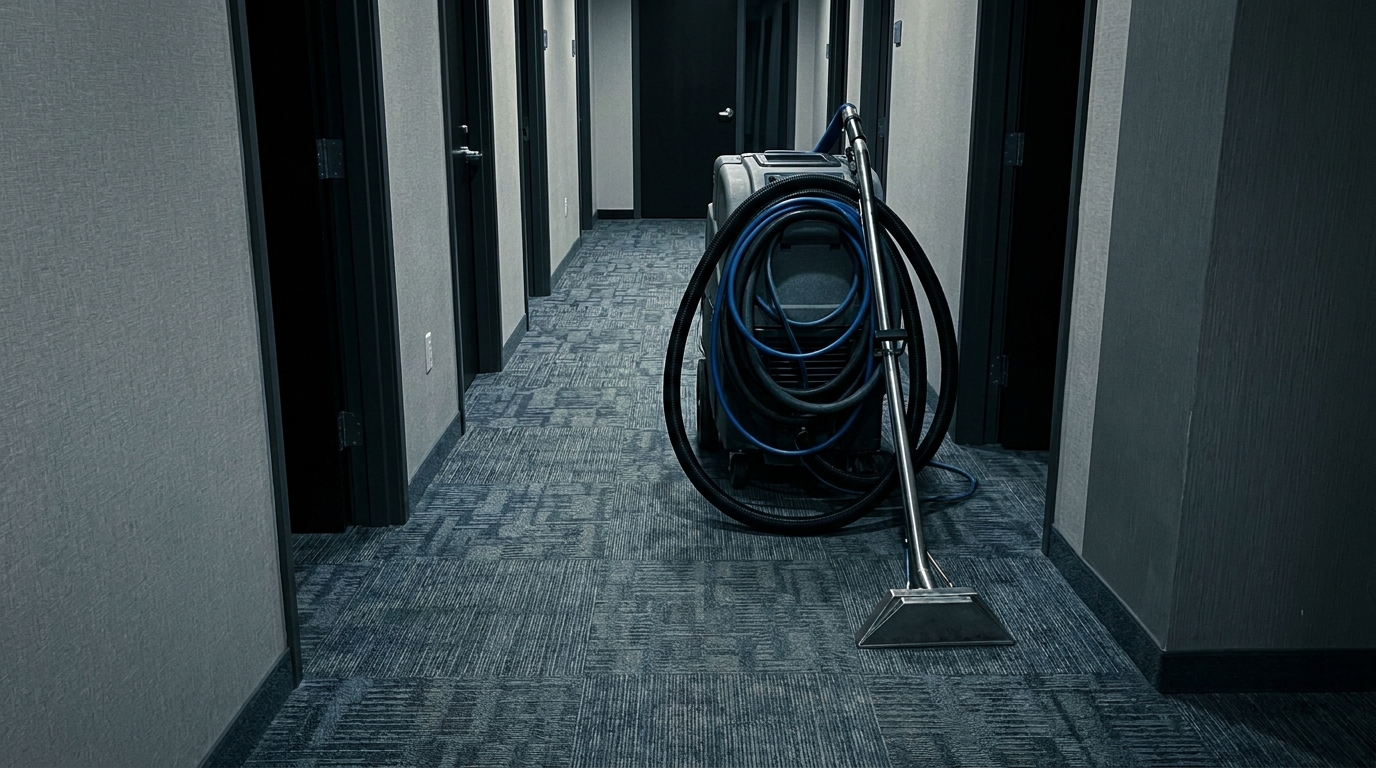
Nightly vacuuming collects dry soil that is still loose on commercial carpet. It does not pull out grit and oils that traffic has ground into the pile, and it does not rinse detergent residue that keeps holding more soil after the tips look tidy [1]. Hot-water extraction is the deep-cleaning step for that embedded load: suspend the soil, rinse it, and recover the water with suction. The Carpet and Rug Institute's 2023 commercial standard defines an extractor as equipment that uses pressure, water or cleaning solution, and suction to remove deeply embedded soil or stains, which is a different result from running the vacuum again [1].
What a vacuum pass is for
The 2023 Carpet and Rug Institute standard, CRI 204, puts vacuuming inside a five-part program: keep soil out, vacuum on a schedule, remove spots, run interim appearance cleaning, and deep clean to take out residues and trapped soil [1]. That standard states that 79% or more of the soil can be removed dry by vacuuming, so a skipped vacuum schedule shows up as gray lanes long before anyone books an extraction [1]. Deep cleaning still starts with a vacuum. Always vacuum first [1].
Traffic sets the pace. For moderate traffic, the 2023 chart calls for daily vacuuming at entrance level and vacuuming of other floors two or three times a week [1]. Heavy traffic moves those other floors to a daily vacuum, and severe traffic can need two passes a day in the lanes [1]. Private offices, meeting rooms, and boardrooms can sit on two or three vacuums a week if the entries are contained [1]. Soil that gets past the door becomes their problem.
Mats do more than a second slow pass with the same machine. Mats that extend for 9 to 15 feet inside the entrance will trap eighty percent of soil and moisture from the first five or six steps, the 2023 standard says [1]. An outside scraper mat and an inside absorbent mat both belong at the door, and they have to be cleaned before they overload or they stop holding soil [1]. Parking lots, sidewalks, and the hard floor at the carpet edge feed the same lanes. During any hard-floor work, whether stripping, finishing, or restoring, keep those solutions off the carpet, because many of them damage fiber if they are tracked across [1]. Strip-and-wax and other finish restoration are a different scope from carpet extraction.
Vacuuming also stirs dust while it removes it. The Environmental Protection Agency's page on indoor particulate matter, last updated on March 10, 2026, describes indoor dust as settled particulate matter that cleaning, vacuuming, and walking easily kick back into the air [7]. That page advises vacuuming carpets every week or more often, considering a HEPA filter so the machine releases less dust, and having people with asthma or allergies leave the area being vacuumed [7]. It is general indoor-air guidance, written with homes in view, not a commercial traffic chart. A staffed lobby needs the tighter CRI entry schedule, not a weekly home cadence. Vacuum on purpose, with a machine that does not blow the load back into the room.
When another vacuum pass will not fix the lane
Schedule extraction when the soil is no longer a dry layer that suction can lift. CRI defines deep carpet cleaning as work that extracts accumulated soils and cleaning residues at a higher intensity, to maximize removal of embedded soil [1]. How often depends on the daily program, location, traffic, and the carpet maker's requirements [1]. The standard also says to deep clean before the soil is easily visible, if the goal is appearance, service life, and any warranty that depends on maintenance [1]. A lane that is already a dark stripe is late. Heavy grit and ice-melt can scratch fiber and dull the way light reflects, and vacuuming only helps limit that abrasion [1]. It does not undo scratches already in the yarn.
We treat these as extraction decisions, not as a request for the nightly crew to slow down on the same lane:
- The gray path returns within a few days of a thorough vacuum, including soil packed at the base of the pile.
- Spots reappear as the carpet dries. CRI calls that wicking: liquid, soil, or leftover contaminant moving from the backing to the fiber tip, which extra air movement can reduce and another dry pass will not [1].
- Spotting chemicals went on heavy and were not rinsed. Detergent residue keeps attracting soil after drying, and more detergent than the label does not clean better [1]. The standard points to a small extractor, or an absorbent compound, for rinsing a spot [1].
- Chair mats went back onto damp carpet, or interim appearance cleaning has been carrying the building while the base of the lane is still stiff with soil.
Oily film from asphalt sealer, fresh paving, or a parking garage is a separate limit. The 2023 standard says carpet can yellow once that material bonds to the fiber, and that it is extremely difficult to remove all of it [1]. Mats and a real cleaning schedule may keep the yellowing from becoming permanent. Extraction is the right deep step. It is not a promise that every parking-lot film will leave. If the carpet maker is unknown, follow CRI 204 [1]. If the maker is known, follow that guidance too. Failure to follow the standard or the maker's guidelines may mean lost warranty coverage and a shorter service life [1]. We do not administer warranties. We can put the interval the warranty asks for on a written schedule.
What hot-water extraction actually does
CRI divides effective cleaning into four steps: dry soil removal, soil suspension, soil removal, and drying [1]. A system has to clean, must not damage the carpet, must not leave excessive residue, and should follow the carpet maker's recommendation [1]. Suspension is the step a vacuum cannot do. After dry soil is gone, what remains has to leave the fiber by chemical action, heat, agitation, and time. Heat reduces the surface tension of water and supports faster cleaning than cold water [1]. Prespray, which the standard calls preconditioning, matters because CRI says it is unreasonable to expect ground-in soil, including oils that have oxidized, to suspend in the few seconds between spraying a detergent and sucking it back up [1]. Agitation spreads that prespray. Dwell time has to match the label, because soil compacted for months does not dissolve on contact [1].
The removal mechanisms are not interchangeable. CRI lists absorbent compounds, wet vacuuming, rinsing by water extraction, and dry-residue vacuuming after an encapsulation solution [1]. Hot-water extraction is the rinsing path. People sometimes call the job steam cleaning. The standard's description is heated water, solution, pressure, and suction, then drying. The order is short: vacuum, mix to the label, prespray, agitate, dwell, then extract with a deep-cleaning system [1]. In general, CRI says, its certified water extraction systems achieved the highest rankings in the Seal of Approval program [1]. Then dry the carpet. Air movers, the HVAC system, or dehumidifiers greatly reduce drying time [1]. Keep people off until it is completely dry, so they do not slip where carpet meets hard floor and do not walk new soil into the damp face. Leave chair mats off until then [1].
Overwetting is the failure mode. Prolonged dampness may discolor the carpet or separate the backing, and that risk is controlled by the equipment and the person running it, not by adding water because a lane looks stubborn [1]. A wet pass that suction cannot recover is a longer dry time, not a deeper clean.
CRI's January 2012 laboratory procedure for Seal of Approval deep extractors, technical bulletin TM 118, measured soil removal, residual moisture, and surface appearance [2]. In that 2012 water-only test, the lowest listed tier started at 55 percent of the test soil removed, and residual moisture had to be at or below 8 ounces per square yard, also stated as 271 grams per square meter [2]. Those figures are listing thresholds from January 2012, not a field promise for an office or clinic in the Carolinas, and the soil test was water only on a prepared sample [2]. The Seal of Approval program described in CRI 204 is a voluntary test of vacuums, extractors, solutions, deep-cleaning systems, and interim systems, and many carpet makers require those products if a warranty is to stay intact [1]. That is a scheduling fact. It is not a certification we claim for Pure Cleaning Solutions.
Low-moisture work is interim, not a substitute
An interim maintenance system, in the 2023 standard, is an encapsulate solution, a counter-rotating brush, and a vacuum [1]. The goal is appearance. It can postpone or limit deep cleaning, and it is meant to put the carpet back in use quickly [1]. It is not the higher-intensity removal of embedded soil and old residue [1]. On our floor-care scope, encapsulation is what we schedule when a wing cannot spare a full extraction dry. The chemistry is quick-dry and low-residue, for high-traffic carpet where extraction downtime is not available. It sits between extraction visits. It does not retire them.
Bonnet cleaning is a different machine. CRI 204 does not recommend rotary equipment on carpet: a head, with or without a brush, pad, or bonnet, that spins across the face [1]. Our floor-care introduction names bonnet cleaning beside extraction. The low-downtime program the page actually describes is encapsulation. A spinning pad can change the look of the tips. It is not a rinse and recovery. The Centers for Disease Control and Prevention's 2003 environmental services discussion describes an aspergillosis outbreak in a transplant unit in which bonnet buffing dispersed Aspergillus spores into the air after a nearby building fire had contaminated the carpet [6]. After wet vacuuming replaced that method, the write-up says no additional cases were identified [6]. One case is not every clinic. It is reason enough not to bonnet-buff healthcare carpet and call it a deep clean.
Drying, downtime, and occupied rooms
CRI states that cleaning is not complete until the carpet is dry and ready for traffic [1]. Drying removes the slip hazard at hard-floor transitions and keeps a damp face from grabbing new soil [1]. Air movers, HVAC, and dehumidifiers assist when hot-water extraction has been used [1]. We do not quote one dry time for every building. Pile, backing moisture, humidity, and air movement all change the clock. The area stays closed to normal traffic until it is dry, and furniture goes back only after that. If we cannot meet the reopen hour, we do not force extraction into that window.
The General Services Administration's December 2024 National Consolidated Maintenance Specification requires extracted carpet in public areas to be dry before customers occupy the building on the next business day, and it holds the contractor responsible for preventing mold [8]. Private offices and clinics in North Carolina and South Carolina are not covered by that federal specification. The planning test is still the right one: night, weekend, or a closed section, rather than a damp lobby at the open of business. The same specification treats private-area extraction as an ordered extra, bars harsh brushing that fuzzes the face, and calls for HEPA vacuums that meet CRI's Seal of Approval program for routine soil [8]. Nightly work owns dry soil. Extraction is a scheduled event with a dry time. Wet-floor signs stay up while the carpet is damp, which matches CRI's note to post signs where cleaning is underway [1].
A clinic adds limits an empty office does not. CDC's summary of its 2003 environmental infection-control guideline says to vacuum public and general patient-care carpet regularly with equipment that limits dust, and to deep clean on a facility schedule with a method that minimizes aerosols and leaves little or no residue [5]. Both items are Category II in that summary. The drying line is Category IB: thoroughly dry wet carpet to prevent fungal growth, and replace carpet that remains wet after 72 hours [5]. The longer 2003 discussion says damp, soiled carpet favors gram-negative bacteria and fungi, and that carpet still damp should be removed, ideally within 72 hours [6]. Vacuuming and wet cleaning can both send microorganisms into the air, and extraction equipment can carry waterborne organisms such as Pseudomonas aeruginosa back onto the carpet if the machine is not maintained and dried between uses [6].
That page also limits the health claim. Bacterial growth on new carpet can level off after about 4 weeks, and vacuuming or cleaning drops those counts only for a while before they rebound [6]. CDC says there is only limited epidemiologic evidence that carpet changes infection rates where patients are immunocompetent [6]. Extraction removes soil and residue. It does not sterilize a floor. The summary rates as Category IB both avoiding carpet in high-spill patient-care zones, including burn units, operating rooms, laboratories, and intensive care units, and not using carpet in hallways and rooms that house immunosuppressed patients [5]. Where a clinic does have carpet in a waiting room or back office, we book the zone empty and finish drying inside that window, well short of the 72-hour line [5]. Spots between extractions still get treated, because a spill that sits stains and holds more soil [1].
The public page for ANSI/IICRC S100, seventh edition 2021, describes procedures for professional cleaning of commercial and residential carpet, including appearance retention, soil removal, and indoor environmental quality, and it notes that a revision of that 2021 edition is underway [3]. A 2021 facilities report on the same publication says the standard does not address restoration of contaminated textile floor coverings and does not compare one cleaning method with another [4]. We do not tell a manager that a standard "requires steam cleaning." Flood, sewage, or a defined outbreak cleanup is outside scheduled extraction.
How often extraction belongs on the calendar
CRI's 2023 chart is a range, not one date for a whole floor [1]. Moderate traffic is deep cleaned 1 to 2 times a year, and monthly in soil-prone areas [1]. Heavy traffic is deep cleaned 2 to 6 times a year, and every two weeks in soil-prone areas [1]. Severe traffic is deep cleaned 2 to 26 times a year, with weekly work in soil-prone areas [1]. Interim cleaning on that chart runs about 1 to 2 times a year for moderate soil-prone areas, 6 to 12 times a year under heavy traffic, and 12 to 52 times a year under severe traffic [1]. A private office and the main entry can sit in different rows. One annual date is right only when the heaviest zone can live with it.
Our recurring floor-care cadence is quarterly, semi-annual, or annual hot-water extraction, with spot treatment between visits. Quarterly lines up with the heavy band on the 2023 chart, and annual lines up with moderate traffic if soil-prone areas are not ignored [1]. A clinic lobby or a door that takes winter grit may need the shorter end, plus encapsulation on the lanes between extractions. Tell us the traffic, the nights the area can stay closed, whether the air system can run for the dry, and whether any zone is a patient area. If a warranty names an interval, that document leads. Hard-floor finish work stays on its own visit so those chemicals stay off the carpet [1].
Practical takeaways
- Vacuum entries on the days they are used. The 2023 CRI standard says 79% or more of soil can come out dry, so the vacuum and the extraction are both required [1].
- Schedule hot-water extraction when lanes gray out after a real vacuum program, when spots wick back, or when detergent residue is attracting soil, and do it before the soil is obvious if you can [1].
- The method is vacuum, prespray, dwell, agitation, then a hot-water rinse that is recovered. Heat helps. Extra detergent beyond the label does not [1].
- Keep the area closed, and keep chair mats off, until the carpet is dry. Use air movement. Prolonged dampness can discolor carpet or separate the backing [1].
- If the space cannot stay closed through a full dry, use encapsulation as the interim step. CRI 204 does not recommend a rotary bonnet on carpet [1].
- In a clinic, limit dust and residue, and dry the carpet well inside 72 hours. Do not run the job through occupied rooms [5].
- On the 2023 CRI chart, moderate use is often 1 to 2 deep cleans a year and heavy use is 2 to 6, with soil-prone zones more often than quiet rooms [1].
- Keep strip-and-wax off this scope. Hard-floor finish chemicals do not belong on the carpet [1].
How we can help
Carpet extraction is part of our floor-care work for offices and clinics across North Carolina and South Carolina. Coverage is densest in the Charlotte metro, with scheduled routes through the Triangle, the Triad, the South Carolina Upstate and Midlands, and the coastal Carolinas. On a recurring program we set hot-water extraction at a quarterly, semi-annual, or annual cadence, include spot treatment between extractions, and use encapsulation where a full dry time is not available. We are fully insured and bonded. A written quote comes back within 24 hours, and no site visit is required to get that quote. If the lanes need extraction instead of another vacuum pass, start with the floor care scope or send the building details.
Citations
- Carpet and Rug Institute, "CRI 204 Commercial Carpet Standard for Maintenance and Cleaning" (2023)
- Carpet and Rug Institute, "CRI TM 118 Laboratory Test Procedure for Seal of Approval Deep Extractor" (2012)
- IICRC, "ANSI/IICRC S100 Standard for Professional Cleaning of Textile Floor Coverings" (2021)
- FMLink, "ANSI/IICRC standard for professional cleaning of carpets, rugs" (2021)
- Centers for Disease Control and Prevention, "Summary of Recommendations, Guidelines for Environmental Infection Control in Health-Care Facilities" (2003)
- Centers for Disease Control and Prevention, "E. Environmental Services, Guidelines for Environmental Infection Control in Health-Care Facilities" (2003)
- US Environmental Protection Agency, "Sources of Indoor Particulate Matter (PM)" (2026)
- General Services Administration, "National Consolidated Maintenance Specification, Version 1.2" (2024)