Commercial Restroom Cleaning Program: What It Covers
Naming restrooms on a night checklist is not a restroom program. A commercial restroom cleaning program is the written plan for fixture cleaning, dispenser and supply par levels, floor and grout work, and daytime touch-ups so the room does not fall apart between nightly visits. OSHA requires washing facilities to be maintained in a sanitary condition, with hand soap and a way to dry hands, which is an all-day condition, not a condition that only has to be true when the night crew leaves [1]. CDC lists restroom fixtures among the high-touch surfaces that should be cleaned regularly, and it says a high-traffic area may need more frequent cleaning, or disinfection in addition to cleaning [3].
What the night sheet still leaves open
A night scope should name the restrooms. That sentence belongs in the janitorial agreement so nobody can claim the rooms were covered by "general cleaning" without a task list. The rest of the program is what that sentence does not do.
A night crew can leave a restroom looking right at the end of the shift and the room can still fail before lunch. Soap runs out. A toilet overflows and gets a courtesy wipe that misses the base. Grout holds soil that a daily mop never lifts. A dispenser jams and people dry their hands on their clothes. None of those failures show up on a checklist that was signed at night and not opened again until the next night.
OSHA's sanitation standard also says every place of employment shall be kept clean to the extent the work allows, and that putrescible waste has to be removed as often as necessary to keep the workplace sanitary [1]. The standard does not give you a clock. It does not say nightly service is enough for a lobby restroom, and it does not say a quiet suite needs a porter every hour. The facility manager writes that clock. If the clock is missing, the crew will do what the night sheet says and skip the hours in between, because those hours were never assigned.
We see this most often in buildings that bought a single nightly visit and then treated every restroom as the same room. They are not the same room. An employee restroom off a back hall and a public restroom off a multi-tenant lobby do not share a schedule just because both have a toilet and a sink.
Fixture cleaning, including the parts people touch
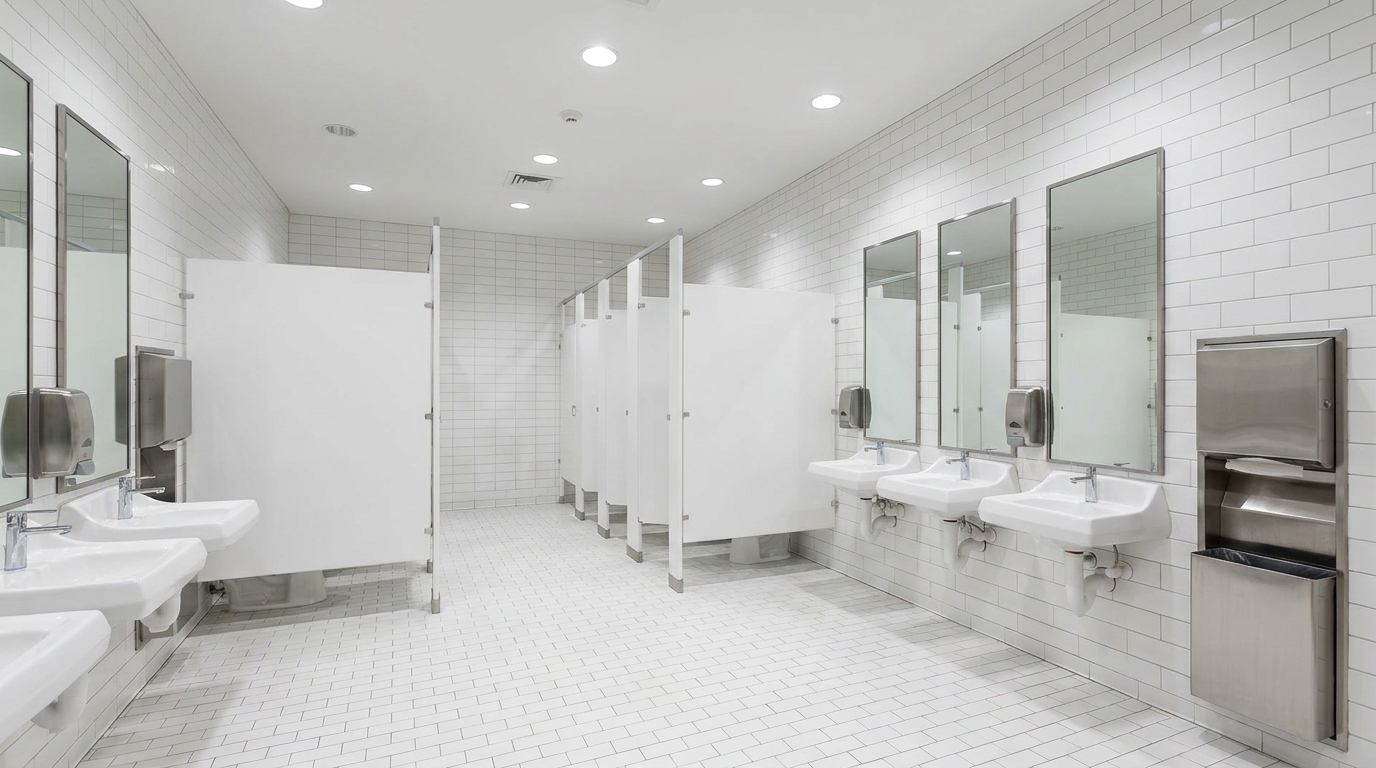
Fixture cleaning means the toilet, the urinal, the sink, and the hardware around them. Inside the bowl matters. So do the seat, the hinges, the flush handle, the underside of the rim, the outside of the bowl, and the bolts at the floor. A sink includes the basin, the faucet, the handles, and the counter where water pools. Partitions, stall latches, door pulls, and dispenser levers belong on the same pass, because those are the surfaces hands actually touch.
CDC's guidance for community settings such as offices, gyms, and businesses says to clean high-touch surfaces regularly, and to clean other surfaces when they are visibly dirty [3]. That page also says the guidance is not written for healthcare, or for other sites that already have their own cleaning rules [3]. A clinic can be a reason to raise frequency. It is not a reason to paste an office checklist into a clinical space, or the other way around.
Cleaning and disinfecting are not the same step. CDC says to clean first, because dirt makes it harder for a disinfectant to kill germs [3]. After the disinfectant goes on, it has to stay on the surface for the contact time, also called wet time, listed in the directions and on the safety data sheet. The surface should stay wet for that entire time [3]. EPA's six-step disinfectant sheet from 2020 says the same thing in plain language: find the contact time in the directions, and keep the surface wet the whole time so the product can work [6]. Wiping the fixture dry as soon as it looks shiny cuts the step short. If the product dries early, the honest correction is to reapply, not to hope the label was padded.
Do not write one contact time into the program as if every bottle shared it. A bowl cleaner, a general restroom disinfectant, and a product chosen for a specific germ can carry different wet times. If the scope calls for disinfection, put the product name and the wet time from that label on the restroom card so the person doing the work is not guessing. CDC also says that in most situations, regular cleaning is enough to limit the spread of germs from surfaces [3]. Disinfection is the added step where people have obviously been ill, or where you choose it because the room is high traffic [3]. A low-traffic office restroom does not need an hourly disinfectant pass to follow that guidance. Toilets and urinals can still be on a disinfectant step, because that is where soil collects, but the wet time has to match the bottle in the caddy.
After cleaning, CDC says to wash hands with soap and water for 20 seconds [3].
Soap, towels, and a par level that is a number
A clean fixture does not help if the sink has no soap. OSHA's overview of restroom requirements says employers must keep restrooms in a sanitary condition and provide hot and cold running water or lukewarm water, hand soap or a similar cleansing agent, and warm air blowers or individual hand towels [2]. The same page says waterless hand cleaner and towels or rags are not adequate substitutes for soap and water [2]. The regulation itself says washing facilities shall be maintained in a sanitary condition, each lavatory needs hot and cold running water or tepid running water, hand soap or a similar cleansing agent shall be provided, and individual hand towels, air blowers, or clean sections of continuous cloth toweling shall be convenient to the lavatories [1].
CDC's workplace hand-hygiene guidance matches that supply list. Good hand hygiene means washing with soap and water for at least 20 seconds and then drying the hands, or using an alcohol-based sanitizer with at least 60% alcohol when soap and water are not readily available [4]. After using the restroom is one of the times CDC tells employers to stress, and the action plan tells employers to provide soap, water, and a way to dry hands in bathrooms [4]. If hands are visibly dirty, CDC says use soap and water rather than sanitizer [4].
Sanitizer is a weak backup in a restroom for another reason. CDC's norovirus prevention page says hand sanitizer does not work well against norovirus and is not a substitute for handwashing [5]. A program that lets the soap dispenser sit empty because a sanitizer bottle is mounted by the door misses the handwashing guidance, and it misses OSHA's point that waterless cleaner does not replace soap and water [2] [5].
Par level is the minimum that should still be in the room at the end of a check, not the quantity someone ordered last quarter and hoped would last. Toilet paper, paper towels, soap, liners, and bags for sanitary-product containers belong on that list. Seat-cover dispensers belong on it if the building uses them. The count is local. A two-stall employee restroom and a busy lobby restroom should not share a guess.
Boise State University's custodial chart, updated in 2026, is a useful public example of how one campus splits the work, not a rule for every Carolina office [7]. On that chart, light-use restrooms, described as low-traffic office areas, restock soap and paper products as needed. Heavy-use restrooms, in buildings with classrooms or event spaces, restock soap and paper products twice a day, and those rooms get a nightly full clean plus daytime portering [7]. The lesson is to pick the pattern that matches traffic, then write the number down. "As needed," with no par and no daytime check, usually means the need is discovered by the next person who finds an empty roll.
Waste sits on the same pass. OSHA requires receptacles for putrescible solid or liquid waste to be built so they do not leak and can be kept sanitary, and it requires that waste be removed as often as necessary so it does not become a health problem [1]. Boise State's chart empties feminine hygiene receptacles daily in both light-use and heavy-use restrooms [7]. That is a sensible floor for a commercial program even when other tasks are lighter. A container that is emptied only on the night someone remembers is how a restroom starts to smell halfway through the week.
The older research CDC cites is worth keeping in view when someone treats supplies as a minor line item. On its April 18, 2024 workplace page, CDC states that handwashing benefits include reducing respiratory illnesses such as colds by 21% and reducing the number of people who get sick with diarrhea by 31%, and the sources listed on that page were published from 2006 through 2011 [4]. Those figures are about handwashing, not about a mop. They still argue for a program that keeps soap and towels in the room during the hours the building is open.
Daytime touch-ups in a high-traffic building
CDC says that if a space is high traffic, you may choose to clean more frequently or to disinfect in addition to cleaning [3]. That is a reason to match the schedule to the building. It is not one interval for every restroom in the Carolinas.
Use the rooms you actually have. A small professional suite with steady employees and little visitor traffic can often live on a full nightly clean, a par that holds through the day, and a clear way to call for a spill or an empty dispenser. A multi-tenant lobby, a school, a busy public counter, or a clinic waiting area usually cannot. Visitors do not wait for the night crew. For clinics, keep the example in its place. CDC's community-facility page says its cleaning guidance is not the rule set for healthcare settings [3]. Higher frequency may be appropriate. The clinical protocol is a separate document.
Boise State shows the split without pretending every campus task belongs in an office [7]. Heavy-use restrooms on that chart get floors swept or dust-mopped twice a day, waste emptied twice a day, partitions and touch points cleaned daily, sinks cleaned daily, and toilets and urinals cleaned and disinfected daily. Light-use restrooms clean sinks and disinfect toilets and urinals daily, but partitions and touch points are three times a week, and waste containers are three times a week or as needed [7]. A commercial program can be stricter than a light-use campus office. It should not be vaguer.
Define the daytime touch-up so it does not balloon into a second full clean, and so it does not shrink into a walk-by. A useful touch-up is short and specific. Bring supplies back to par, empty trash that is full, wipe fixtures and touch points that are visibly soiled, spot-mop wet floors, check that toilets and urinals flush, and note anything that needs a plumber or a full re-clean. Put the times on the schedule. Mid-morning and mid-afternoon mean something. "As needed" does not, unless a named person is in the building and the need is defined.
In our janitorial work, that daytime pass is porter work, separate from the night crew's full clean. The night crew still owns the detailed fixture clean. The porter owns the hours when people are using the room. If both are written as "restrooms" with no split, one of them will be skipped. It is usually the pass that happens while the building is open and the crew is trying to get to the next account.
Floors, grout, and the scrub that is actually scheduled
Floor care in a restroom is not the same job as a lobby floor program, and it should not be buried there. Most of these rooms are tile. A mop removes loose soil. It does not, by itself, reset grout that has taken on soil and odor over months.
Boise State's chart is an example of separating the daily task from the periodic one, not a calendar to copy [7]. Light-use restrooms on that chart wet-mop weekly and scrub tile floors by request. Heavy-use restrooms wet-mop daily and scrub tile floors three times per year. Partitions, walls, and vents sit on their own lines, from daily or weekly work out to an annual dusting of vents [7]. Copying those intervals into a Charlotte office would ignore the actual traffic. Using the structure would not. Mopping is one line. A scrub with a date on it is another line. "When it looks bad" is how the scrub gets postponed until a tenant complains.
Write the scrub to include the edges, the corners, the area under partitions, and the floor around the base of each fixture. Those are the spots a mop swing misses. In our work, a restroom that still smells after the fixtures look fine usually has the problem in the grout, around the fixture base, in a slow drain, or in a trash container that was lined and never washed. Fragrance does not fix that. The program should say who does the scrub, how often the interval is reviewed, and what done means, including a rinse where the product label says to rinse.
Periodic work can also cover partition edges, dispenser interiors, and vent dust on a longer cycle than the nightly clean. Put those on the same calendar as the floor scrub so they are not invented later as a surprise extra. The point is to decide them when the scope is written.
When someone has been sick in the room
Routine cleaning is not the same event as a vomit or diarrhea cleanup, and the program should not mash them into one line that says "disinfect restrooms."
CDC's facility guidance says to disinfect, in addition to cleaning, areas where people have obviously been ill, and it gives vomiting on facility surfaces as the example [3]. For norovirus, the prevention page is more specific. After someone vomits or has diarrhea, wear gloves, wipe the area with paper towels, and throw the towels in a plastic trash bag [5]. Disinfect as the product label directs. CDC says to use a chlorine bleach solution at 1,000 to 5,000 ppm, which it describes as 5 to 25 tablespoons of household bleach (5% to 8%) per gallon of water, or an EPA-registered product with a norovirus claim, and to leave bleach disinfectant on the affected area for at least 5 minutes [5]. Then clean the area again with soap and hot water, handle laundry and trash, and wash hands [5].
That sequence will not fit in the margin of a night checklist. The program needs a short response note: who is called, whether the restroom is blocked until the wet time is finished, where the bleach or the listed disinfectant is stored, and how the waste leaves the building. CDC also notes that norovirus can remain in stool for 2 weeks or more after the person feels better, which is one reason a single emergency wipe is a weak plan for the days that follow [5]. Hand sanitizer still does not replace soap and water for this virus [5].
Keep this section in its lane. It is a body-fluid response inside a restroom program. It is not a whole-room spray plan, and it is not a clinical protocol. The product, the wet time, and the cleanup order are what the crew needs on paper before the event, not after.
How to write the program so rooms stop getting skipped
A facility manager can draft this on a few pages. Name every restroom. A label like "all restrooms" is how a storage-closet toilet or a first-floor public room gets missed. Note who uses each one, and whether traffic is light or heavy on a normal day, not on the quietest day of the year.
Split tasks into three columns.
Every visit, including a daytime touch-up: par check, trash if full, spot clean of visibly soiled fixtures and touch points, spot mop, flush check, and a note if something is broken.
Nightly, or on the full-clean days you actually bought: full fixture clean inside and out, dispensers wiped, mirrors, partitions and hardware on the schedule you chose, floors mopped, sanitary containers emptied, and supplies brought back to par at the end of the clean.
Periodic: tile and grout scrub, dispenser interiors, partition detail, vent dust, and a wash of trash containers, each with a month or a season attached.
Add four operating lines. First, the product name and the contact time from the label if the scope includes fixture disinfection [3] [6]. Second, the par counts. Third, the body-fluid steps, including the bleach concentration and the 5-minute wet time CDC describes for that cleanup, or the wet time on the EPA-registered product you actually stock [5]. Fourth, the daytime times and the name of the role that owns them.
Then decide how a skip is reported. An empty dispenser, a missed room, or a restroom closed by a clog should be a same-day note to the facility contact, not a surprise at a quarterly review. Review the program when headcount, tenants, or public access changes. A restroom that was light-use in the spring can be heavy-use after a new tenant opens to the lobby.
OSHA still sits under the document, not instead of it. Employers have to provide enough toilets for the workforce, with prompt access, and they have to let workers leave their work location to use a restroom when needed [2]. A cleaning program does not satisfy that duty by itself. A locked, undersupplied, or fouled room is a poor match for a standard that calls for sanitary, available toilets [2]. The program is how the rooms stay in that condition between the nightly visits.
Practical takeaways
- Treat the night checklist as the full clean, then write a separate restroom program for supplies, daytime touch-ups, and periodic scrubs.
- List fixture cleaning inside and out, including flush handles, seat hardware, sink handles, stall latches, and door pulls.
- Clean visible soil before disinfecting, and keep the surface wet for the contact time on that product's label [3] [6].
- Set par levels for soap, towels, toilet paper, liners, and sanitary-product bags. Do not treat a sanitizer dispenser as a substitute for soap and water [2] [5].
- Match daytime checks to traffic. A quiet suite and a public lobby do not share a schedule [3] [7].
- Put tile and grout scrubs on a dated calendar. A mop is not a scrub.
- Write the vomit and diarrhea response before you need it, including wet time, and keep healthcare sites on their own rules rather than an office checklist [3] [5].
How we can help
Pure Cleaning Solutions works in North Carolina and South Carolina, with the densest coverage in the Charlotte metro. Restroom work sits inside our janitorial programs, not as a separate service line: dedicated rotations, supply restocking, fixture cleaning, floor care, and periodic deep scrubs, kept separate from the general scope so the restroom does not get skipped. You can see how we structure that ongoing work on our janitorial services page. Tell us about the building and we will send a written quote within 24 hours, with no site visit required. Start at our contact page.
Citations
- eCFR, "29 CFR 1910.141 Sanitation" (2026)
- Occupational Safety and Health Administration, "Restrooms and Sanitation Requirements" (2026)
- Centers for Disease Control and Prevention, "When and How to Clean and Disinfect a Facility" (2024)
- Centers for Disease Control and Prevention, "About Hand Hygiene at Work" (2024)
- Centers for Disease Control and Prevention, "How to Prevent Norovirus" (2025)
- US Environmental Protection Agency, "Six Steps for Safe and Effective Disinfectant Use" (2020)
- Boise State University Campus Operations, "Restroom Cleaning Frequency Chart" (2026)