Commercial Day Porter: When to Add Daytime Rounds
A night crew puts the building back in order after people leave. It does not restock a restroom at midmorning, take a wet spill off the lobby floor while visitors are walking through, or catch a break-room can that has already overflowed. A commercial day porter is the daytime coverage for those occupied-hour jobs, and it is the right add when traffic will run restrooms, the lobby, or waste past a sanitary condition before the night crew returns. OSHA requires employers to maintain restrooms in a sanitary condition and to provide hand soap or a similar cleansing agent, plus warm air blowers or individual hand towels, and it states that waterless hand cleaner and towels or rags are not adequate substitutes for soap and water [1].
What a night crew is for
A night crew is a reset. The floor is empty, doors can be locked, and the work can move room by room: fixtures, trash, floors, and the dust that settled while the building was open. That pass is what makes the morning look right. It is not the same job as standing in the building while people are using it.
Colorado State University's campus chart dated May 1, 2025 sets restroom trash removal, disinfection of sinks, toilets, urinals, and tubs, dispenser and partition disinfection, sweeping, and disinfectant mopping as daily work, and it sets daily spot cleaning of entrance glass plus daily vacuuming of lobby carpet and walk-off mats [9]. That chart is a university schedule, not a commercial office contract. On the same pages, office cleaning is much lighter than a leased suite should be, so we do not borrow those office lines. We use the chart for a narrower point: a single thorough pass can be built to hit a daily restroom and lobby standard.
CDC guidance for community settings such as offices, gyms, businesses, and community centers, posted April 16, 2024, says to clean high-touch surfaces regularly, including door handles, stair rails, elevator buttons, and restroom fixtures, and to clean other surfaces when they are visibly dirty [3]. If the space is high traffic, that same page says you may choose to clean more often, or to disinfect in addition to cleaning [3]. In most of those community settings, the page says regular cleaning is enough to limit the spread of germs, and that surfaces should be cleaned before they are sanitized or disinfected [3]. The page also says, more than once, that this guidance is not for healthcare settings. A clinic does not borrow the office paragraph and call the question closed.
The practical gap is timing. The issue is not whether someone cleans. The issue is whether the only clean happens after occupants have already spent the day with an empty soap dispenser, a wet floor, or a full can.
When daytime coverage is the right add
Boise State University's custodial chart splits restrooms into light use and heavy use. Light-use rooms sit mainly in low-traffic office areas. Heavy-use rooms, in buildings with classrooms or event spaces, get a nightly full clean plus daytime portering for high-touch tasks [6]. On the heavy-use list, sweeping or dust mopping, emptying waste, and restocking soap and paper are each shown twice a day, while fixture disinfection, mirrors, partitions, and wet mopping stay on a daily line [6].
That split is the part worth copying, even though the labels were written for a campus. Daytime coverage on a busy restroom is not a second copy of the night scope. It is the short cycle that keeps supplies up and waste down while the full clean still happens once. A quiet office restroom often does not need that second cycle. A shared toilet that turns over all morning usually does.
Rowan University's custodial task list, in a PDF created on November 17, 2017, already allowed for the same judgment [7]. Restrooms are cleaned and sanitized daily, soap and paper are checked and restocked as needed, and a second servicing may be provided in high-use areas [7]. The document is a campus list from 2017, not a current national code, and it notes that weather, events, and staffing can move the work [7]. The department's stated goal on that list is to perform at APPA Level 2 rather than slip to Level 3. On the definitions printed with the list, Level 2 still calls for washroom fixtures that gleam and are odor-free, with supplies adequate, even though floors may show up to two days of dust, dirt, stains, or streaks [7]. Read that plainly. A night crew can own the dust. It cannot keep supplies adequate in the afternoon if the dispenser failed late in the morning.
University of Northern Iowa's cleaning frequency guide, updated September 9, 2021, lists a daily restroom replenishment of toilet paper, paper towels, and soap, with daily cleaning and disinfection of toilets, urinals, sinks, touch points, and floors [8]. Locker rooms on that same 2021 guide step fixture, touch-point, sink, and shower cleaning up to twice a day [8]. Private offices on the guide drop to twice a year, which is a campus choice and not a model we would write for a commercial suite [8]. The narrow lesson is that the same department shortens the cycle on fixtures when use gets heavier, instead of assuming the nightly clean still covers the room.
We look for a few conditions before we recommend daytime hours on top of a night program.
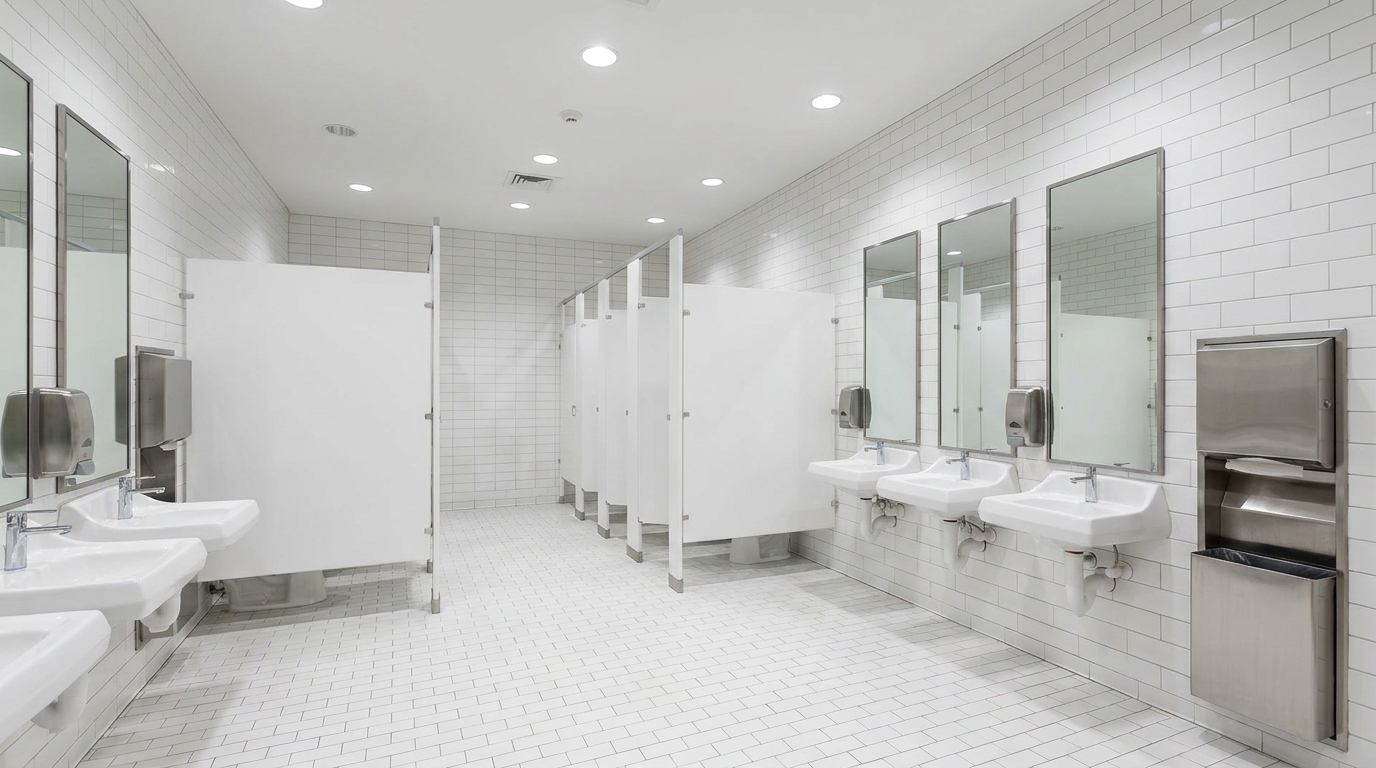
Shared restrooms with a real midday load. A small office where a handful of people use two stalls, and the dispensers still have product in the afternoon, usually does not need a porter. A multi-tenant floor, a training room that fills up, or a clinic toilet used by patients and visitors usually does. Boise's light-use versus heavy-use split is the right question to ask on the walk-through [6].
Waste that peaks while the building is open. Under 29 CFR 1910.141, food-waste receptacles must be built and placed so they do not result in overfilling, and they must be emptied not less often than once each working day unless they are unused [2]. The same section says sweepings, solid or liquid wastes, refuse, and garbage must be removed in a way that avoids a health hazard and as often as needed to keep the workplace sanitary [2]. A night dump can meet the once-a-day line. It does not meet the overfilling line if the break-room can is already past full after lunch. That is a daytime pull, not a reason to duplicate the entire night clean.
Floors that get wet while people are still in the building. The sanitation standard says every place of employment shall be kept clean to the extent the work allows, and the floor of every workroom shall be maintained, so far as practicable, in a dry condition [2]. A coffee spill in a corridor, a rain-soaked mat, or water on a restroom floor is a daytime problem. Leaving it until the night crew arrives leaves a slip hazard in an occupied space. The porter's job is to dry it, set a wet-floor sign, and note a leak if the water comes back. It is not to strip the floor.
A body-fluid spill. CDC's norovirus prevention page, updated January 13, 2025, says that after someone vomits or has diarrhea, the whole area should be cleaned well and disinfected immediately [4]. The page also says hand sanitizer does not work well against norovirus and is not a substitute for washing with soap and water, and it tells people to wash for at least 20 seconds, especially after using the toilet [4]. On the April 16, 2024 page for community facilities, CDC separately says to disinfect surfaces where people have obviously been ill, and it gives vomiting on facility surfaces as the example [3]. That community page is not written for healthcare. In a clinic, follow the practice's own rules for blood and body fluids. A porter line is not an infection-control program. The scheduling point is simpler: someone has to be allowed to clean that spill while patients are still in the building, or you need a call-out that does not wait for the night shift.
A lobby that is the public face all day. Entry glass, door pulls, and mats collect hands and weather while the desk is open. The night detail makes the open look right. It does not hold a wet afternoon. If clients, patients, or tenants judge the building from that path, a short lobby round belongs in the scope. If the entrance is a locked stair used by the same ten people, it probably does not.
Consumables as a system, not a surprise. CDC's workplace hand-hygiene page, dated April 18, 2024, tells employers to provide soap, water, and a way to dry hands, and to clean frequently touched surfaces such as countertops, handrails, and doorknobs on a regular basis [5]. OSHA's restroom overview states the parallel duty: hot and cold running water or lukewarm water, hand soap or a similar cleansing agent, and warm air blowers or individual hand towels [1]. The sanitation standard adds that washing facilities shall be maintained in a sanitary condition, with soap and towels or an air blower at the lavatories [2]. An empty dispenser in the afternoon is a failure of supply, not a detail for the crew that arrives after close. If the only thing a porter ever finds is an empty roll, fix the par level and the reorder. Do not buy extra hours to keep discovering the same shortage.
OSHA also requires sanitary toilet facilities that are immediately available, and it tells employers not to impose restrictions that cause extended delays [1]. A porter does not replace that access duty. A locked restroom or a restroom with no soap is a bad condition either way. Daytime cleaning does not excuse a bad access rule, and a good access rule does not restock the towel dispenser.
Skip the porter when the occupied-hour walk is boring. If midmorning and midafternoon both show stocked dispensers, dry floors, cans with room left, and a lobby that still looks cared for, keep the spend on the night scope and on periodic project work. A person wandering an empty suite is not a program.
What to put in the daytime scope
Write the daytime scope as rounds, not as a second night specification. The rounds should be short enough that the porter is moving, and specific enough that a new person can run them without inventing the job.
Restrooms. Each round should check dispensers against a par level, spot-clean fixtures and partitions that are visibly soiled, wipe touch points, empty trash before it overflows, pick up paper from the floor, and dry wet spots. The full fixture clean and the disinfectant mop of the whole floor can stay with the night crew unless the room is heavy use. Boise's heavy-use chart is a fair model of that division: restock and waste twice a day, full fixture disinfection on the daily clean [6]. Rowan's 2017 list is the lighter version: one daily service, and a second servicing only where use is high [7]. The porter should also note recurring plumbing problems, a dispenser that will not latch, and odors that a wipe does not fix. Those notes are how you stop buying the same emergency every week.
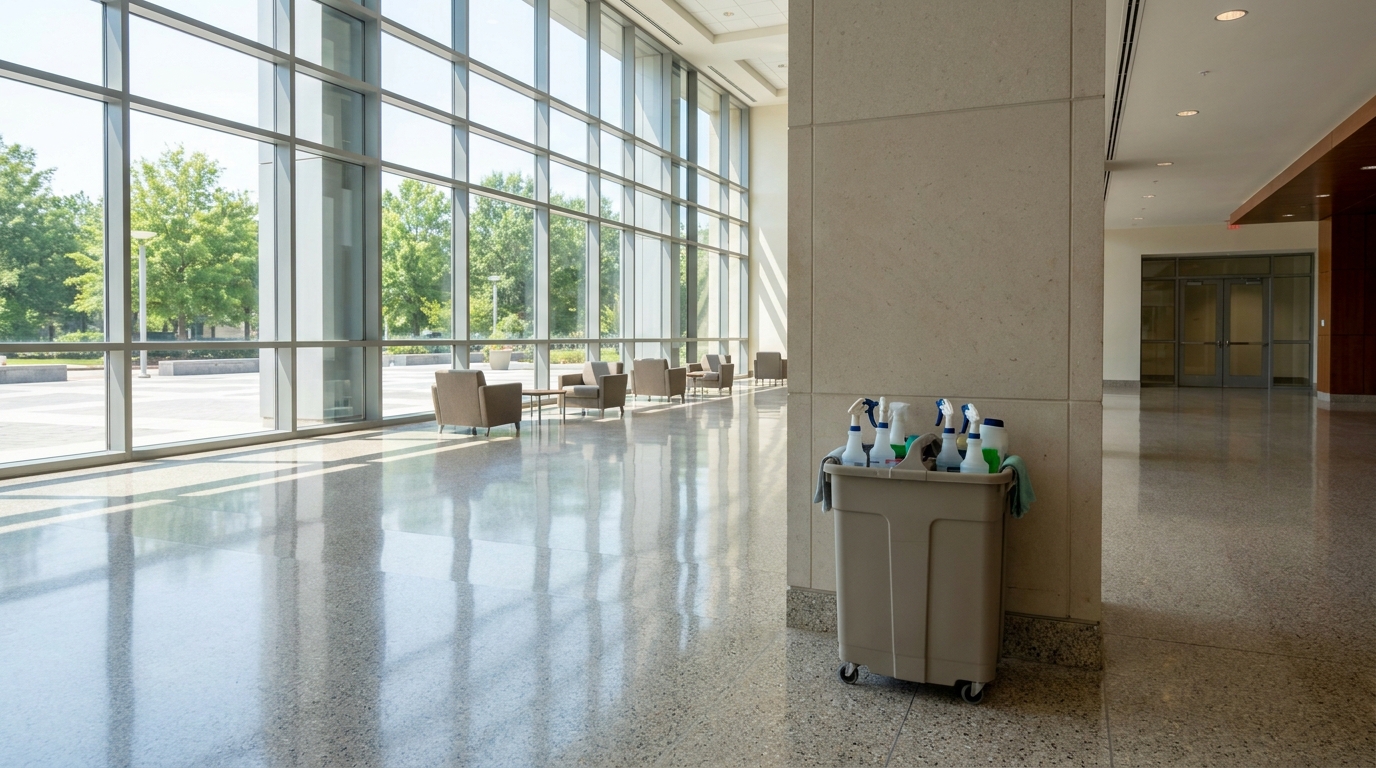
Lobby, entries, and elevators. Spot-clean glass and pulls at hand height, straighten the mat, pick up debris, and dry spills. Elevator tracks, buttons, and the floor inside the cab pick up traffic all day, so a wipe and a spot mop belong on a busy round. Do not schedule carpet extraction, a finish job, or high dusting while the desk is open. Those tasks need an empty floor and they belong on the night crew or on a scheduled project.
Break rooms. Wipe counters and the sink when they are clear of people's food, and pull trash and recycling as the cans head toward full. Leave dishes, the inside of the refrigerator, and personal containers alone unless the contract says otherwise. OSHA's food-waste rule is about overfilling and a daily empty, not about washing someone's lunch box [2]. If the can is the wrong size for the lunch crowd, say so. A larger can or a second pull is cheaper than a complaint about smell.
Conference rooms and waiting rooms. A reset between meetings is straightening the room and a spot wipe of the table, plus a check of the floor for spills. It is not a vacuum of the whole room unless that room turns over all day. In a clinic, the daytime pass that belongs with a porter is the waiting room, the path in from the weather, and the toilet patients share. Exam-room turnover between patients is clinical work. Do not hide it inside a porter line so the janitorial price looks complete. We keep medical cleaning on its own scope for that reason.
Spills. Give the porter a written path: what they may clean, which approved product they use, where the wet-floor sign is, and who they call for a backup or a leak. CDC's January 13, 2025 norovirus page says the area is cleaned and disinfected immediately after vomit or diarrhea, with gloves, and that the waste goes out with the trash [4]. The scope does not need a homemade dilution ratio. It needs the product the facility has already approved, the contact time on that label, and a rule that the porter does not mix chemicals to improvise. For ordinary dirt, the April 16, 2024 community guidance says regular cleaning is enough in most situations, and disinfection is the add-on where someone has obviously been ill or where you choose it because traffic is high [3]. That same page tells employers to train people on labels, ventilation, and protective equipment before assigning disinfecting work, and it says not to mix products [3].
Leave these off the day list: private-office dusting, a full vacuum route, trash that can wait until night without overflowing, vent cleaning, and any floor machine. If the day list starts to look like the night list, the building does not need a porter. It needs a longer night shift, a second night cleaner, or a scope someone has been skipping.
How daytime work differs from after-hours cleaning
The two crews fail in different ways, so they should not be judged with one walk-through.
The night crew works after close. The goal is a reset: every room on the list, trash out, restrooms fully cleaned, floors done to the frequency you bought. People generally do not watch the work. Access is keys, alarms, and a building that can take a wet floor for a while. The checklist is long because the space is empty.
The porter works while the building is open. The goal is to hold a condition, not to rebuild it. Rounds are short and tied to peaks, often shortly after open, late morning, after lunch, and midafternoon. People see the uniform, so the work has to be quiet, the product cannot hang in a conference room, and a wet floor needs a sign and a path around it. The kit is small. Machines that close a corridor do not belong on this shift.
Consumables flip the handoff. If a porter is on the account, the night crew should not be the first person to discover that soap ran out at lunch. The porter fills to the par level and writes down what will not stay full. The night crew does the full clean and flags what the porter should watch the next day: a leak, a mat that stays soaked, a can that is undersized. Without that note, you pay two people to be surprised by the same problem.
Inspection has to match the shift you are buying. Walk in the morning, before anyone has used the building much, and you are grading the night crew. Walk at midmorning and again an hour after lunch, and you are grading whether daytime coverage is needed or is actually happening. One visit after the cleaners leave will never show you an empty towel dispenser. One visit at 8 a.m. will never show you the lunch trash.
Hours should follow the failure, not a default full day. Many accounts need those four touches and nothing else, which can be a part-day shift. Heavy public restrooms may need tighter rounds. A quiet professional suite may need none. We would rather write targeted rounds than place someone on site with nothing real to do. Do not use a porter to cover up a weak night crew. If the building opens dirty, fix the night scope, the access, and the supervision. Daytime hours will not vacuum the suite that was skipped.
How to decide on a Carolina account
Walk a normal day, not a holiday week and not only the night the cleaners are there. Use the same route a visitor uses.
In each restroom, check soap, towels or the dryer, toilet paper, the sanitary container, the floor around the fixtures, and the trash. One bad hour can be a fluke. The same failure on two walks is a scope problem. In the lobby, look at glass at hand height, the mat, and the path to the desk. In the break room, look at the cans after lunch, not before the building opens. In a clinic, look at the waiting room and the toilet patients use, and keep the exam rooms on the medical scope.
Then match the purchase to what failed. One midday restroom and lobby round is a different buy from an all-day porter. Write the rounds, the zones, and the exclusions into the janitorial agreement. A verbal extra disappears the first time the site contact changes. Name who buys paper and soap. A restock round with an empty closet is not a service. If we hold the supply program, we track and reorder those consumables. If you buy them, the porter still needs a stocked closet and a person to tell when the count is wrong.
We do this work in North Carolina and South Carolina only, from our Matthews headquarters. Coverage is densest in the Charlotte metro, including Charlotte, Matthews, Concord, Huntersville, Gastonia, Rock Hill, and Fort Mill. We also work the Triangle and the Triad, South Carolina's Upstate and Midlands, and the coastal Carolinas. The test does not change between a Columbia clinic and an office in Huntersville. Walk the building while it is occupied, then buy the hours that match what you saw.
Practical takeaways
- A night crew resets an empty building. A day porter holds restrooms, spills, the lobby, and consumables while people are still there.
- Do not add daytime coverage by default. Add it when a midmorning or midafternoon walk shows empty dispensers, wet floors, waste that has overflowed, or a lobby that no longer looks kept.
- Heavy shared restrooms need a short daytime cycle on top of the nightly full clean. Boise State's heavy-use chart puts restocking and waste on a twice-a-day line and leaves full fixture disinfection on the daily clean [6].
- OSHA's restroom overview requires a sanitary restroom, soap, and a way to dry hands, and it says waterless cleaner and rags are not a substitute for soap and water [1].
- Food-waste cans must not be set up to overfill, and a once-a-day empty meets the sanitation standard only if the cans did not overflow during the working day [2].
- Vomit or diarrhea is an immediate clean and disinfect, not a note for the night crew, on CDC's norovirus page updated January 13, 2025 [4].
- Keep full floor work, a detailed vacuum route, and private-office dusting on the night scope. Daytime rounds are short on purpose.
- Part-day rounds tied to open, late morning, after lunch, and midafternoon are often enough. An all-day porter is for heavy public traffic.
- For clinics, daytime coverage of waiting rooms and shared toilets is a scheduling choice. It is not a stand-in for the practice's infection-control rules, and CDC's April 16, 2024 community cleaning page does not apply to healthcare [3].
- If you reuse the campus examples, date them. Rowan is a 2017 list, Northern Iowa updated its guide on September 9, 2021, and Colorado State's public-area chart is dated May 1, 2025 [7] [8] [9].
How we can help
Day porter coverage is a program inside janitorial service, not a separate trade. Night crews, daytime rounds, restroom work, and supply management can be scoped together or added only where the walk-through shows a need, and the details are on our janitorial services page. We are fully insured and bonded, our crews work in English and Spanish, and we serve North Carolina and South Carolina from Matthews. Tell us about the building and we will send a written quote within 24 hours, with no site visit required, or schedule a walk-through if you want one: contact Pure Cleaning Solutions.
Citations
- Occupational Safety and Health Administration, "Restrooms and Sanitation Requirements - Overview" (undated)
- Electronic Code of Federal Regulations, "29 CFR 1910.141 Sanitation" (2026)
- Centers for Disease Control and Prevention, "When and How to Clean and Disinfect a Facility" (2024)
- Centers for Disease Control and Prevention, "How to Prevent Norovirus" (2025)
- Centers for Disease Control and Prevention, "About Hand Hygiene at Work" (2024)
- Boise State University Campus Operations, "Restroom Cleaning Frequency Chart" (2026)
- Rowan University Facilities, "Facilities Custodial Services Operations Task Frequencies" (2017)
- University of Northern Iowa Facilities Management, "Cleaning Frequency Guide" (2021)
- Colorado State University Facilities Management, "University Cleaning Standards and Frequency" (2025)