Chemotherapeutic Cleaning: What to Require Before Hiring
Chemotherapeutic cleaning is not a heavier version of night janitorial work. It is a hazardous-drug (HD) decontamination job: residue on chairs, counters, floors, pumps, and waste chutes is a documented occupational exposure risk, and the crew that wipes it has to be trained, suited, and logged like any other HD handler.[1] Before you hire a vendor, require a site walk, dedicated equipment that never leaves the HD zone, chemistry matched to your facility SOP, PPE that meets the handling standard, and a waste handoff that stays on your regulated stream. Most commercial cleaners decline this work because they are not built for it. We quote it after we walk the floor.
Residue does not stay in the hood
NIOSH estimates that about 8 million U.S. healthcare workers can be exposed to hazardous drugs, and the list of people at risk is not limited to pharmacists and infusion nurses. Environmental services workers, shipping and receiving staff, and anyone who works in rooms where these drugs are used sit on the same exposure list.[1] Published studies have associated workplace HD exposure with skin rashes, adverse reproductive outcomes (including infertility, spontaneous abortion, and congenital malformations), and a possible increase in leukemia and other cancers. The risk tracks how much a worker is exposed and how toxic the drug is.[1]
That exposure is not theoretical dust from a compounding hood. OSHA's hazardous-drug guidance summarizes decades of wipe sampling on biological safety cabinets, countertops, floors, and door handles. Those studies have repeatedly found widespread contamination. A 1999 multi-site study in the United States and Canada found measurable hazardous-drug residue on 75 percent of pharmacy samples and 65 percent of nursing treatment-area samples.[3] OSHA notes that more than 80 later studies of the ambient work environment have been published, and most of them still detected at least one marker drug.[3] Current belief, based on that body of work, is that dermal absorption from contaminated surfaces is the primary route of exposure for at least some agents (cyclophosphamide is the usual example), with inhalation as an additional route for drugs that vaporize.[3]
The practical point for a clinic or infusion center is simple. Residue travels. It shows up on the chair arm after an infusion, on the floor in front of the cabinet, on the pass-through, on the waste chute, and on surfaces that never held a vial. OSHA is explicit that surfaces in storage, mixing, administration, waste, and patient-care areas have all tested positive in published work.[3] If your cleaning vendor treats those rooms like a medical office waiting area, they are not doing chemotherapeutic cleaning. They are spreading a chemical that was designed to kill cells.
NIOSH's current list of hazardous drugs in healthcare settings (the 2024 list) is the identification tool employers use to decide which drugs in the building trigger this handling regime. It replaced the 2016 list, added 25 drugs, and removed 7.[2] Your vendor does not need to memorize the tables. Your vendor does need to work from the list your facility actually handles, and from the SOP your designated person already wrote.
What the standards actually require of cleaning
USP General Chapter <800>, Hazardous Drugs, Handling in Healthcare Settings, became official on December 1, 2019, and became compendially applicable (to the extent <795> and <797> apply) on November 1, 2023.[4] The chapter exists because of the same public-health problem NIOSH documents: roughly 8 million U.S. healthcare workers can be exposed each year, and there was no single public standard for handling before <800> was written.[4] It covers more than compounding. Handling includes receipt, storage, compounding, administration, disposal, and cleaning.
The cleaning language is not a suggestion to "use a hospital-grade disinfectant." <800> lists four steps: deactivation, decontamination, cleaning, and disinfection.[4] Deactivation is the chemical step that renders the drug inactive or inert. If the drug labeling does not name a specific agent, USP's FAQ guidance is to use an EPA-registered oxidizer (peroxide formulations or sodium hypochlorite are the examples given).[4] Decontamination is the physical removal of residue onto a wipe or mop that then becomes waste. Cleaning removes soil and leftover chemistry. Disinfection is required in sterile compounding areas after the first three steps.
State boards that reprint the chapter are even more direct. Washington's pharmacy self-inspection addendum restates the <800> rule that all areas where HDs are handled, and all reusable equipment and devices, must be deactivated, decontaminated, and cleaned, with sterile compounding areas subsequently disinfected.[5] The entity must have written procedures that name the agents, dilutions, frequency, and documentation. Personnel who perform those activities must be trained to protect themselves and the environment, and they must wear PPE that resists the cleaning agents used, including two pairs of chemotherapy gloves and impermeable disposable gowns. Eye protection and face shields are required if splashing is likely.[5] Louisiana's Board of Pharmacy reprint of the same chapter lists the same PPE trigger list: receipt, storage, transport, compounding, administration, deactivation/decontamination/cleaning/disinfecting, spill control, and waste disposal.[6]
Wipe sampling is recommended, not required. There is currently no national numerical limit for "acceptable" HD surface contamination.[4] If a facility samples and finds residue, the designated person has to identify the cause, contain it, retrain if needed, and repeat the deactivation, decontamination, and cleaning until the next sample supports that the process worked.[4] A vendor who cannot produce a visit log (scope, chemistry, crew, timestamps, exceptions) is not giving your designated person anything to put in that file.
OSHA does not have a standalone hazardous-drug standard, but it does require employers to assess workplace hazards and to select and enforce PPE under 29 CFR 1910.132, plus chemical-barrier eye and face protection under 1910.133 when splashes or aerosols are reasonably expected.[7] Hazard communication under 1910.1200 still applies to most of these agents. A janitorial contractor who shows up in a cotton smock and a pair of utility gloves is not meeting that bar, and the facility still owns the exposure.
Dedicated equipment, PPE, and chemistry
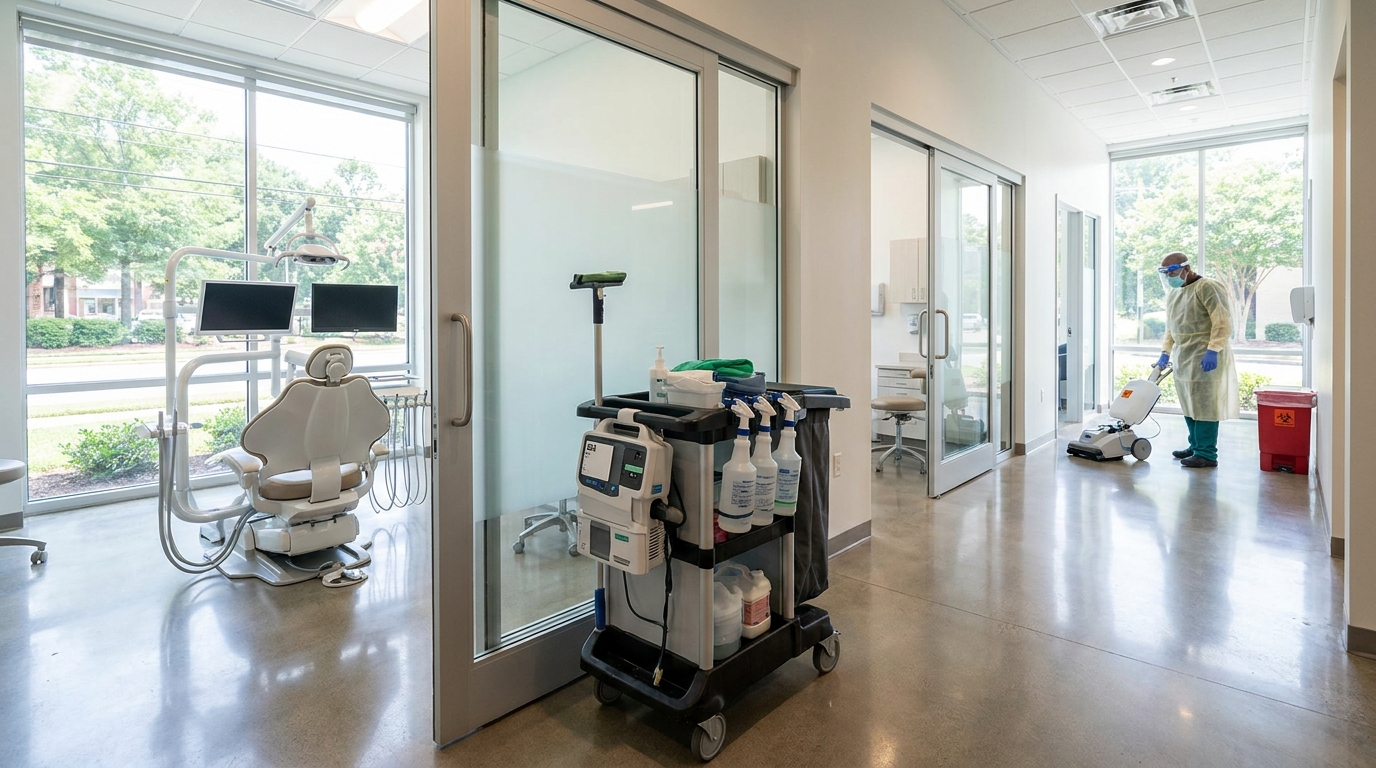
<800> does not let you "wipe down the mop and use it on the admin suite tomorrow." Disposable or clean compounding equipment that contacts HDs must be dedicated to HD use. Equipment (or parts of equipment) that comes in direct contact with HDs must be dedicated. Equipment that does not contact HDs may be shared only after it is deactivated, decontaminated, and cleaned before it leaves the HD area.[4] We apply the same rule to the tools that actually clean the room. HD-zone mops, buckets, and microfiber stay with that account. They are never cross-used with a standard commercial building. Single-use wipes go in when the SOP calls for them.
PPE is not optional garnish. For compounding, USP requires gowns, head and hair covers, two pairs of shoe covers, and two pairs of gloves that meet ASTM D6978.[4] Disposable PPE is not re-worn. Everything worn while handling HDs is treated as contaminated with at least trace residue and goes into the proper waste container, further disposed of under local, state, and federal rules.[4][6] For cleaning and deactivation work, the reprinted chapter language is the same two pairs of chemotherapy gloves plus an impermeable disposable gown, with eye and face protection when splash is likely, and respiratory protection when the task (for example, cleaning inside or under a cabinet) requires it.[5][6] Surgical masks are not respiratory protection for drug exposure.[5]
Chemistry is matched to your SOP, not to whatever bottle is on the vendor's truck. For chemotherapeutic decontamination that typically means a validated surfactant-based cleaner followed by a sodium hypochlorite or peroxide deactivator, with a neutralization step where the oxidizer and the surface require it. We do not bring unvalidated products into a compounding or infusion environment. If your SOP names a specific sequence, that is the sequence. If it does not, we walk it with your designated person before the first billed visit.
NIOSH's 2023 guidance on managing hazardous-drug exposures is useful here for what it refuses to do. It will not hand you a one-size control table and call the job done. Potential exposure depends on dosage form, route, frequency and magnitude, work practices, and which engineering, administrative, and PPE controls are actually in place. NIOSH tells healthcare settings to run a facility-specific assessment and then pick controls from the hierarchy: elimination or substitution where feasible, then engineering controls, then administrative controls, then PPE.[8] PPE is the least effective layer. It is still required when the other layers are incomplete, which they always are on an open infusion floor.
That is why we will not quote chemotherapeutic cleaning from a floor plan emailed at 4 p.m. We walk the facility with your clinical or pharmacy lead, read the SOP, look at the waste stream, and write the scope. No handshake-only work.
Waste stays on your stream. We do not haul it.
This is the item that catches facilities after they have already hired the wrong vendor. Cleaning produces waste: used PPE, wipes, mop heads, and sometimes spill debris. Under EPA's Management Standards for Hazardous Waste Pharmaceuticals (40 CFR Part 266, Subpart P), a healthcare facility's non-creditable hazardous waste pharmaceuticals include residues remaining in empty containers, contaminated personal protective equipment, floor sweepings, and clean-up material from spills of pharmaceuticals.[10] The 2019 rule also prohibits sewering hazardous waste pharmaceuticals. EPA estimated the sewer ban would keep 1,644 to 2,300 tons of hazardous waste pharmaceuticals out of waterways each year.[9]
We are a cleaning contractor, not your hazardous-waste transporter. Contaminated PPE, wipes, and any removed contaminated materials are bagged, labeled, and handed to your facility's regulated medical waste or HD waste stream under your existing vendor contract. We do not transport HD waste off-site. If a prospect asks us to "just take the bags," the answer is no. That is how a cleaning job turns into a RCRA problem.
The same discipline applies to spills. EPA requires healthcare facilities operating under Subpart P to contain spills of non-creditable hazardous waste pharmaceuticals immediately and to manage the clean-up materials as non-creditable hazardous waste pharmaceuticals.[10] We can quote emergency spill response as a separate scope, and we can train your on-site team on first-response containment so the scene is stable until we arrive. Response time depends on distance from our nearest Carolina metro base. It is not a standing promise to appear in 15 minutes from every rural infusion suite.
Why most commercial cleaners decline, and what that tells you
The work most volume office cleaners refuse is not mysterious. HD training is job-specific, not a weekend certificate. PPE adds cost and donning time. Equipment has to be segregated so a mop from an oncology bay never goes into a law office. The waste stream needs chain-of-custody documentation. The insurance profile is different. So they decline, or they say yes and then send a generalist crew with the same bucket they used on the dental practice down the hall.
Facility managers at oncology practices, infusion centers, and compounding pharmacies often call a string of vendors before they find one willing to quote. That is not a sales line. It is the market telling you the work is real. Our tagline is blunt because the work is blunt: we take the jobs other cleaners will not. We have been a commercial-only operation since 2002, headquartered in Matthews, North Carolina, serving North Carolina and South Carolina. We do not clean houses. We do assign the same crews to the same accounts. We keep visit logs. Crews are bilingual (English and Spanish). The phone is answered 24/7. We are insured and bonded. None of that replaces HD-specific training, dedicated equipment, or a written scope. It is the floor we already stand on before we walk yours.
Training for this service is facility-specific documented HD handling, not a single national certification we can flash at a Joint Commission tracer. Every crew member who works a chemotherapeutic account completes that training. Records stay on file and are available when your compliance team asks.
What to require in writing before you hire
Ask for a site walk. If a vendor will quote chemotherapeutic cleaning from a square-footage number, they are quoting janitorial. Walk the patient bays, chemo chairs, pump stations, staff prep, soiled utility, waste chutes, and (if you compound) the C-PEC, anteroom, and pass-throughs. Have your designated person in the room.
Ask what equipment will be used, and where it lives when it is not on your floor. Dedicated, labeled, never cross-used is the only acceptable answer.
Ask what chemistry they will bring, and whether they will substitute it without your written approval. The correct answer is "your SOP," not a brand they prefer.
Ask who wears what, and how used PPE is discarded. Two pairs of ASTM D6978 chemotherapy gloves and an impermeable gown are the baseline for deactivation and cleaning work in HD areas.[5][6] Used PPE is trace-contaminated at minimum and belongs in your HD or regulated medical waste container, not a black bag in the loading dock.
Ask who hauls the waste. If the answer is "we will take it," you are talking to the wrong contractor. Bag, label, handoff.
Ask for the log. Scope completed, chemistry used, crew on site, time stamps, exceptions. That log is what your Board of Pharmacy file and your Joint Commission binder can actually use.
Ask for insurance that covers the specialty scope, and for a certificate that can name the facility if your lease requires it. Ask whether the crews are W-2 employees or a rotating subcontractor pool. Continuity matters when the work is this specific.
If you also need routine medical-area cleaning outside the HD zone (waiting rooms, non-HD exam, staff offices), keep that scope separate on paper even if the same company holds both. Mixing HD and non-HD equipment is how residue leaves the suite. Our medical and healthcare cleaning work and our chemotherapeutic cleaning work are related. They are not the same kit.
Practical takeaways
- Treat chemotherapeutic cleaning as HD decontamination, not as a premium janitorial add-on. Surface residue on chairs, floors, counters, and waste paths is a documented dermal-exposure route.[1][3]
- Hire against USP <800>'s four-step process (deactivation, decontamination, cleaning, disinfection) and against your own SOP, not against a disinfectant label.[4][5]
- Require dedicated HD-zone equipment, ASTM D6978 double gloving, impermeable gowns, and a written visit log. Anything less is a generalist crew in a medical building.[4][5][6]
- Keep HD waste on your facility's regulated stream. Contaminated PPE and spill debris are not ordinary trash, and they are not the cleaning vendor's to haul.[9][10]
- Do not accept a quote without a site walk. If the vendor will not walk the chairs, the chute, and the SOP with your designated person, they are not ready to clean them.
How we can help
We quote chemotherapeutic cleaning only after a site walk-through and a review of your existing SOP. No commitment, no pressure, just a written scope that names the rooms, the chemistry, the equipment segregation, the PPE, and the waste handoff. If that is the conversation you have been trying to have with vendors who keep declining, request a site walk-through or call 980-419-5497.
Citations
- NIOSH / CDC, "Hazardous Drugs Exposures in Healthcare" (updated 2026-03-03)
- NIOSH, "NIOSH List of Hazardous Drugs in Healthcare Settings, 2024" (DHHS (NIOSH) Publication No. 2025-103, December 2024)
- Occupational Safety and Health Administration, "Hazardous Drugs - Controlling Occupational Exposure to Hazardous Drugs" (OSHA living guidance; Connor 1999 figures dated in body)
- United States Pharmacopeia, "USP <800> FAQs" (updated 2026-01-21)
- Washington State Department of Health, Pharmacy Quality Assurance Commission, "USP 800 – Hazardous Drugs Addendum" (2024 file; 2026 Responsible Manager worksheet reprinting USP <800> text)
- Louisiana Board of Pharmacy, "USP General Chapter <800> Hazardous Drugs – Handling in Healthcare Settings" (official-status reprint, 2020-07-01)
- Occupational Safety and Health Administration, "eTool: Hospitals – Pharmacy – Preparation & Handling of Hazardous Drugs" (citing 29 CFR 1910.132 and 1910.133)
- NIOSH, "Managing Hazardous Drug Exposures: Information for Healthcare Settings" (DHHS (NIOSH) Publication No. 2023-130, April 2023)
- U.S. Environmental Protection Agency, "Final Rule: Management Standards for Hazardous Waste Pharmaceuticals and Amendment to the P075 Listing for Nicotine" (rule published 2019-02-22; page updated 2026-01-22)
- eCFR, "40 CFR Part 266 Subpart P, Hazardous Waste Pharmaceuticals" (current through 2026-08-26; originally 84 FR 5940, 2019-02-22)