Commercial Window Washing for Offices and Clinics
Commercial window washing on an office or clinic is not a storefront spray-and-walk. A real scope covers interior glass (conference walls, partitions, reception) and exterior glass, uses ladder, pole, or water-fed pole systems on low- and mid-rise buildings, and treats post-construction residue as a separate, more aggressive job than a quarterly rinse. OSHA's general-industry fall-protection rule requires protection for an employee on a walking-working surface with an unprotected side or edge that is 4 feet (1.2 m) or more above a lower level, which is why access method belongs in the scope before anyone picks up a squeegee.[1] Facility managers who buy an occasional wipe of the front door are not buying that program.
Interior glass is a different job than exterior glass
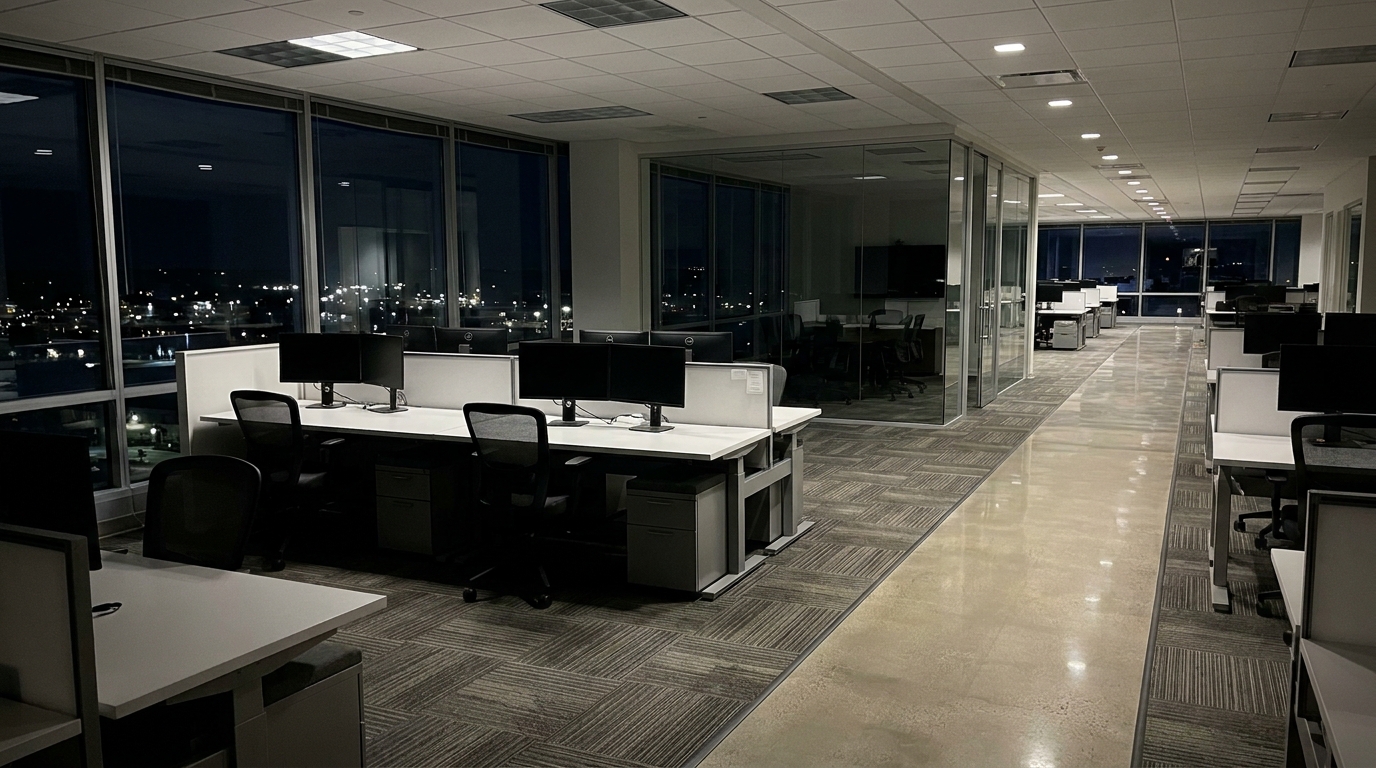
Interior commercial glass collects fingerprints, cosmetics, beverage splash, tape residue, and the film that HVAC systems leave on partitions. Conference-room walls, glass offices, sidelights, and reception storefronts sit at eye level all day. Occupants notice streaks the same afternoon the crew leaves. Exterior glass collects a different soil: pollen, rain spots, traffic film, irrigation overspray, and the grit that blows off parking lots. Those two soils do not come off with the same motion, the same chemistry, or the same access plan.
The National Glass Association (NGA), in a 2020 glass technical paper written with the International Window Cleaning Association (IWCA), tells building managers to clean interior and exterior glass as dirt and residue appear, to soak the surface with a mild, non-abrasive solution, and to keep razor blades out of routine work.[2] That paper also warns that glass can be permanently damaged if it is cleaned infrequently or with the wrong method, which is the practical reason a clinic or office should not wait until the glass looks gray from the parking lot.[2] Coated, tinted, and low-E glass needs extra care. NGA tells cleaners to identify whether a reflective coating is on the exposed face before they start, and to avoid cleaning tinted or coated glass in direct sunlight because surface temperature can make spotting and coating damage more likely.[2]
Interior work also has to respect the room. A conference wall sits over carpet, chairs, and power. Overspray on a wood table or a fabric panel is a complaint, not a detail. Exterior work has to respect pedestrians, parked cars, and the water that runs off a facade onto a sidewalk. OSHA requires employers to keep walking-working surfaces clean, orderly, and sanitary, and to keep those surfaces free of hazards such as spills.[3] Window work that leaves a slick entry is not finished, even if the glass is clear.
Storefronts are not mid-rise buildings
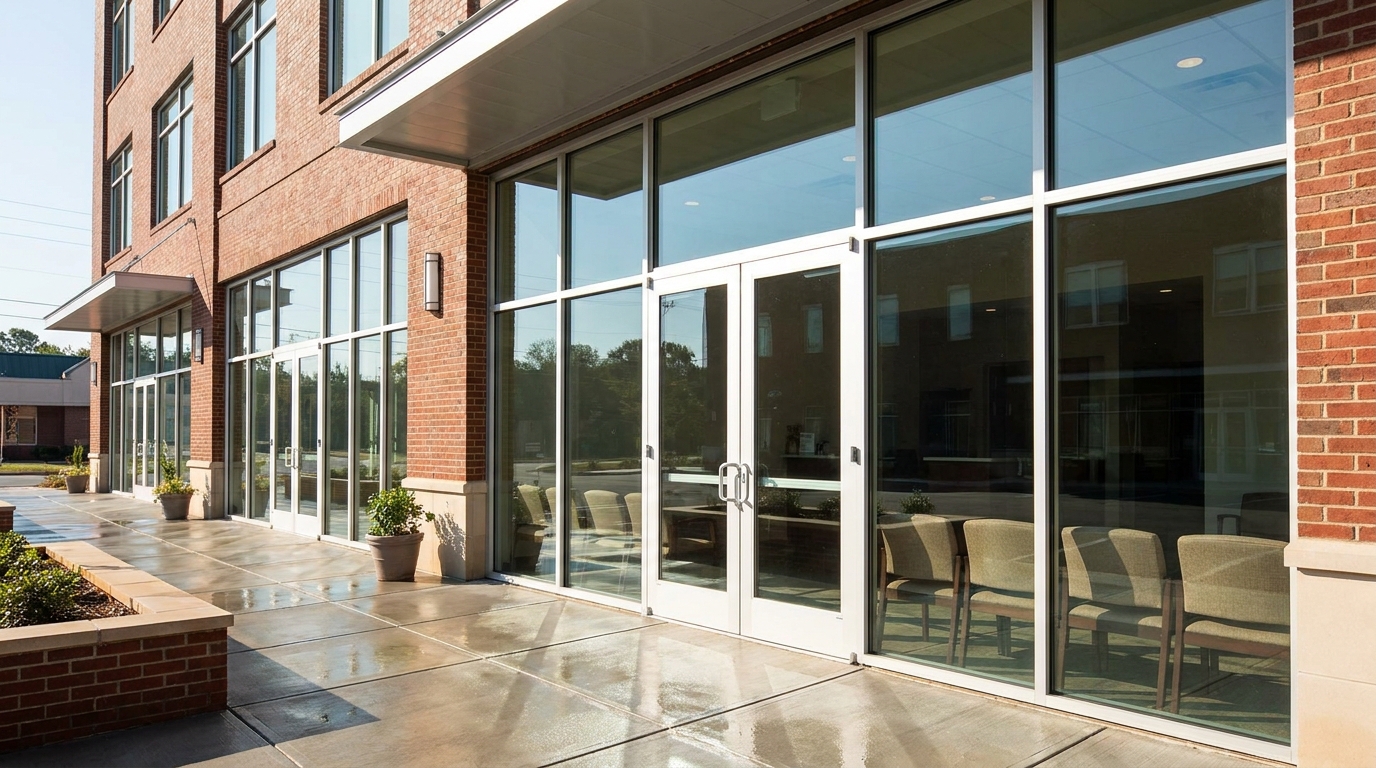
A ground-floor retail or clinic storefront is high-touch public glass. Patients, vendors, and staff put hands on it all day. It is the first surface a visitor judges. That glass usually needs a tighter cadence than the rest of the building, often monthly or more, because fingerprints and door-handle smear return quickly. Frames, sills, and the glass around automatic doors belong in that scope. If the crew only hits the lite and leaves the metal filthy, the entrance still looks neglected.
A low-rise or mid-rise office or medical building is a different production problem. Height, setbacks, landscaping, and overhead lines decide whether a pole, a ladder, or a lift is the right tool. OSHA's portable-ladder rules require ladders to be used only on stable and level surfaces unless they are secured or stabilized, and they forbid moving, shifting, or extending a ladder while an employee is on it.[4] Those rules sound basic until a crew tries to work a sloped planting bed or a busy patient drop-off. A walk-through that maps window count, height, glass type, and access is how we write a scope that can actually be performed.
We focus on mid-sized commercial buildings. Storefronts, ground-floor retail, low-rise and mid-rise exteriors, medical and dental patient-facing glass, office interiors, and atrium or skylight glass that we can reach safely from the floor, a ladder, or a lift all fit. A "tower" package that assumes rope work does not.
What we will not take on
OSHA writes a separate standard for rope descent systems. Before any rope descent system is used, the building owner must tell the employer in writing that each anchorage has been identified, tested, certified, and maintained so it can support at least 5,000 pounds (2,268 kg) in any direction for each employee attached, and the employer must keep that information for the duration of the job.[5] The same standard bars rope descent use above 300 feet (91 m) unless the employer shows that other access is not feasible or would be a greater hazard.[5] That is high-rise, skyscraper, and suspended work.
We do not take it. Our commercial window washing stays on ladder, pole, and water-fed pole systems, with a lift only where the building and the site make that the safer choice. If a facility in the Charlotte metro or elsewhere in the Carolinas needs rope-access or suspended-scaffold glass, that is a different contractor and a different insurance conversation. We will say so rather than stretch a mid-rise method onto a high-rise facade.
Medical and clinic glass needs a tighter brief
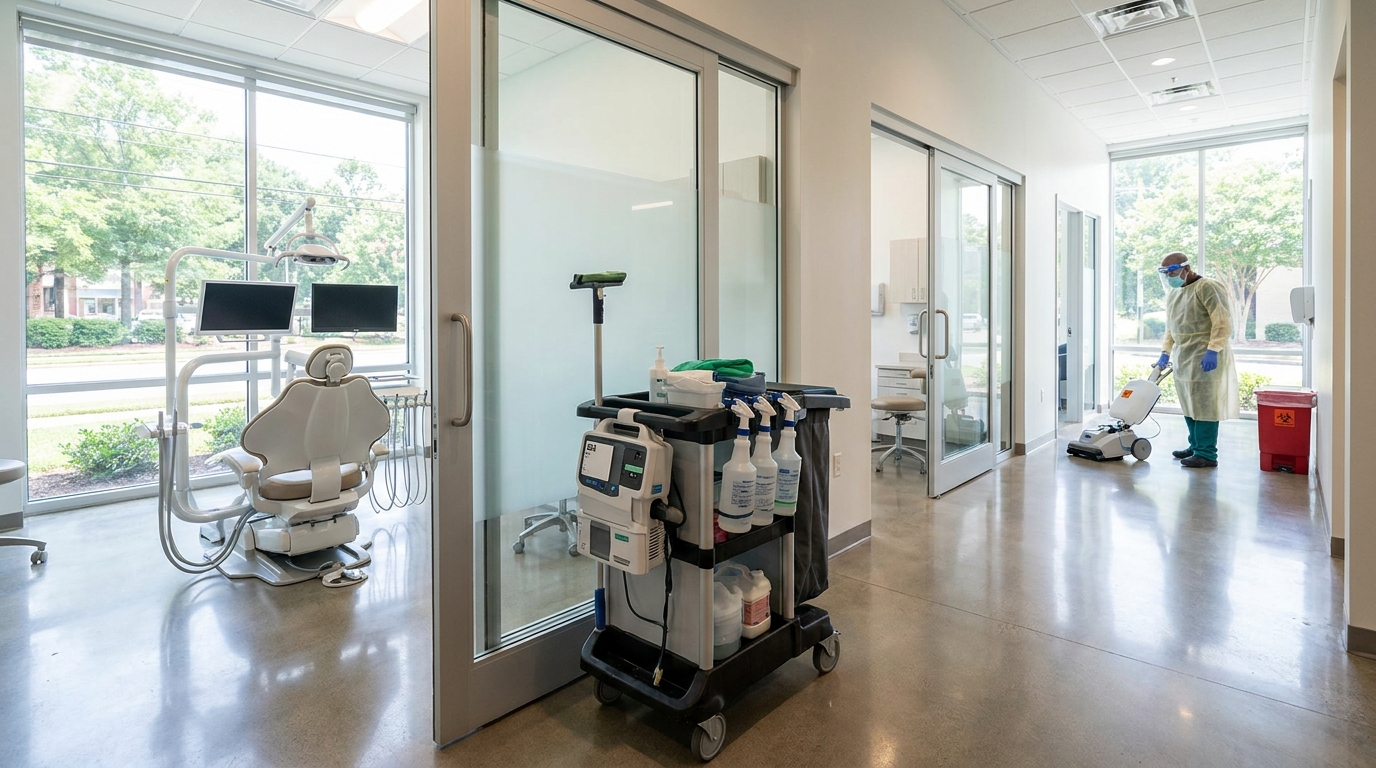
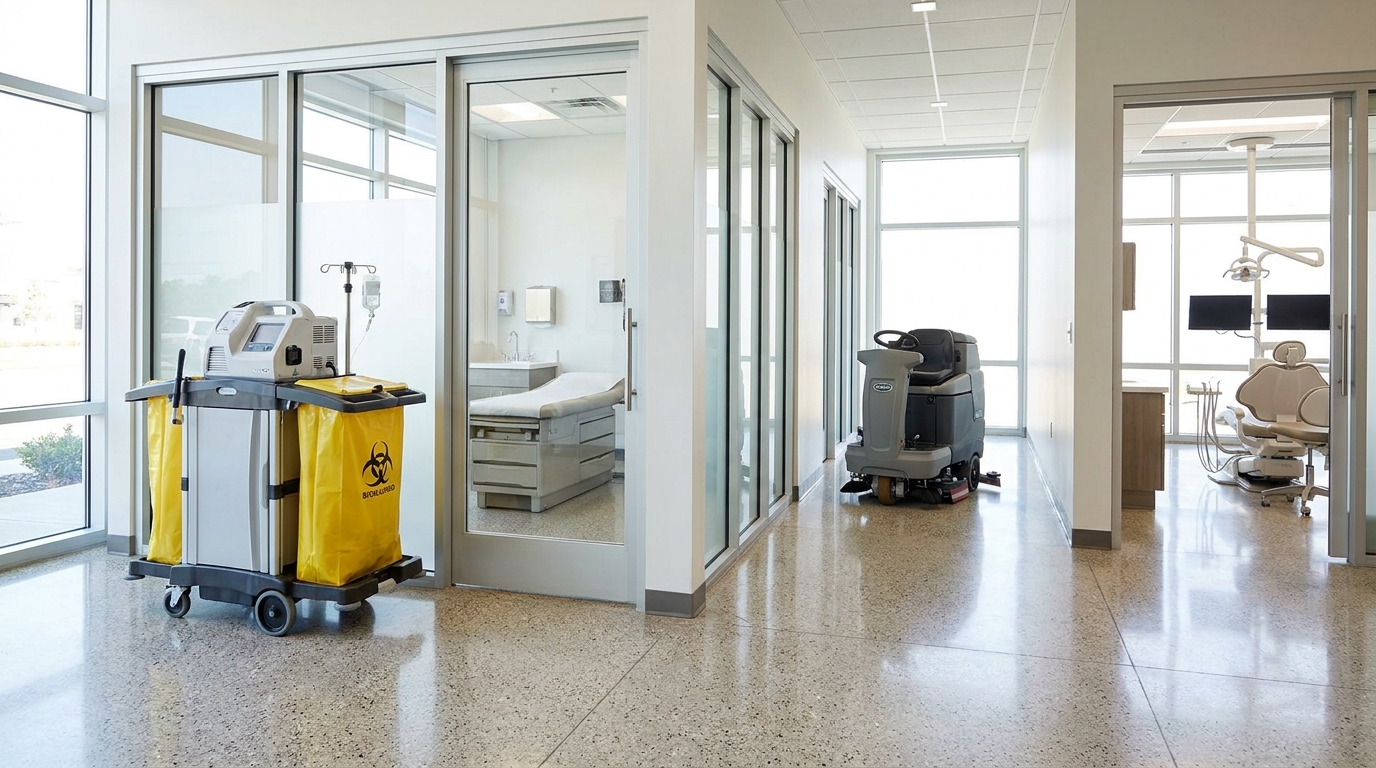
A medical or dental building is still commercial glass, but the people walking past it are patients, not only tenants. Entry glass, reception partitions, and the interior lites that face waiting rooms are part of how the practice presents itself. CDC's environmental-services guidance (originally issued in 2003, still posted for healthcare environmental services) treats window sills in routine patient-care areas as horizontal housekeeping surfaces that need cleaning on a regular basis, when soiling occurs, and at discharge, and it recommends cleaning walls, blinds, and window curtains when they are visibly soiled.[6] That is not a claim that window washing replaces disinfection. It is a claim that glass and the sills under it are part of the room the patient sees.
Chemistry has to respect that setting. CDC's disinfection recommendations say detergent and water are adequate for surfaces in nonpatient-care areas such as administrative offices, while patient-care areas call for an EPA-registered hospital disinfectant when there is uncertainty about soil or about multidrug-resistant organisms on the surface.[7] Window solution that fights the disinfectant already specified for an adjacent sill or reception desk is the wrong product. We coordinate patient-facing glass around clinical hours, keep overspray off exam-room equipment, and treat the entry as a public surface, not as a Saturday retail wipe.
Do not mix this scope with specialty clinical work. Chemotherapeutic cleaning and regulated medical protocols are separate service lines. Window washing in a clinic is still window washing. It just cannot ignore who uses the door.
Post-construction glass is not a quarterly rinse
New glass on a build-out or a renovation collects stickers, tape, plaster splash, stucco overspray, paint, and the grit other trades leave behind. NGA's 2020 paper treats that work as non-routine post-construction cleaning and restoration, not as ordinary maintenance, and it states that any non-routine method carries a risk of irreparable damage.[2] The same paper lists the soils that routinely force a more aggressive approach: paint or varnish overspray, mortar or cement splash, silicone smeared onto glass and frames, and sealer runoff from masonry.[2] Razor blades, when they are used at all, belong only on the affected area of non-coated glass, in one direction, with a new blade. They are not a routine tool, and they should not be used on coated glass.[2]
That is why we write post-construction glass into a window scope instead of assuming the night crew can "hit the windows" after the painters leave. If the building is still in a broader turnover clean, our post-construction glass work sits inside that larger close-out. We have already described what a move-in-ready commercial close-out includes, including construction debris on glass, in what commercial post-construction cleanup includes. The point for a facility manager is simpler: sticker and plaster removal is a defined window-washing task, with a defined risk, and it should be priced and scheduled as such.
Why a recurring program beats an occasional squeegee
Dirt that sits on architectural glass is not only ugly. NGA's 2020 guidance tells owners not to allow dirt and residue to remain on glass for an extended period, and it treats a regular maintenance schedule as part of protecting the product, not as a cosmetic extra.[2] The same paper offers twice per year as a general starting point, then immediately notes that some regions need more frequent service because of environmental factors and atmospheric pollutants.[2] Charlotte-metro pollen, summer storms, and busy clinic entries are exactly those factors. A twice-a-year exterior pass may hold on a quiet mid-rise elevation. It will not hold on a medical storefront that sees a full waiting room every weekday.
A recurring commercial window washing program is how you match frequency to the glass. Typical cadences we write into a scope:
- Storefront and patient-entry glass: monthly or every other month, because hands and weather hit it constantly.
- Office and clinic interiors (partitions, conference walls, reception): monthly to quarterly, depending on occupancy and how much the glass is touched.
- Low- and mid-rise exteriors: quarterly or semi-annual, with a heavier pass after pollen season or after nearby construction.
- Atrium or skylight glass we can reach from the floor, a ladder, or a lift: on the same exterior cadence, or as a separate interior high-glass visit.
- Post-construction or turnover glass: one-time, then the building joins the recurring program.
An occasional squeegee looks cheaper until the glass has mineral spotting, construction film, or a coating that no longer takes a routine wash. Restoration is slower, riskier, and easier to argue about than a scheduled program. Recurring work also lets the same crew learn the building: which lites are coated, which sills weep, which doors cannot be blocked during clinic hours, and which elevations need a pole instead of a ladder.
Access, ladders, and water-fed poles
Falls from portable ladders are not a theoretical risk on this trade. NIOSH reports that in 2020 there were 161 workplace fatalities from ladders and 22,710 workplace injuries from ladders, and it states that in about 40% of cases the ladder-related injury came from the ladder sliding out at the base because of an incorrect setup angle.[8] That is why we would rather put a water-fed pole on a mid-rise elevation than run an extension ladder past the height where setup, footing, and traffic can be controlled.
NGA and IWCA already recognize pure-water cleaning through a specialized extension pole: a non-scratching brush, a final rinse, and rinse water that is allowed to evaporate, with total dissolved solids at 20 parts per million or less so the glass does not spot as it dries.[2] That method is how we reach many exteriors from grade without putting a person on the wall. It is not a substitute for interior squeegee work, and it is not a license to ignore wind, overhead lines, or a wet sidewalk. It is the right tool when the building, the height, and the glass type support it.
When a ladder is the right tool, OSHA still governs the setup. Portable ladders belong on stable, level surfaces unless they are secured. They are not moved with a person on them. Employees face the ladder when climbing and use at least one hand to grasp it.[4] Those constraints are part of why a "we will get the second story from the parking lot" promise is not a scope. If the elevation cannot be reached that way, we say so in the walk-through and we write the method that can.
Practical takeaways
- Write interior and exterior glass as separate line items. They soil differently, they clean differently, and they fail differently.
- Put storefront and clinic-entry glass on a tighter cadence than quiet mid-rise elevations. Hands and weather set that schedule, not a generic twice-a-year note.
- Name the access method in the scope: ladder, pole, water-fed pole, or lift. Do not assume rope descent or high-rise suspended work is included, and do not hire us for that work.
- Identify coated, tinted, laminated, and low-E glass before the first wash. NGA's 2020 procedures treat unknown coatings as a damage risk, not as a detail to sort out later.[2]
- Treat post-construction glass (stickers, plaster, stucco, paint) as non-routine restoration, not as a free add-on to a quarterly rinse.[2]
- In medical buildings, keep window chemistry compatible with the EPA-registered products already used on adjacent housekeeping surfaces, and schedule around clinical hours.[7]
- Include sills, frames, and the glass around automatic doors. CDC still lists window sills among the horizontal surfaces that need regular cleaning in patient-care areas.[6]
- Inspect walking-working surfaces around the work. Spills at an entrance are an OSHA housekeeping problem, not a finished window job.[3]
How we can help
Pure Cleaning Solutions is a commercial-only contractor based in Matthews, NC. We have been in this work since 2002, and we take the mid-sized office, clinic, and retail glass that volume cleaners often treat as an afterthought. Our crews are bilingual (English and Spanish), fully insured and bonded, and available for 24/7 emergency response. We will write a window-washing scope from a walk-through or from photos, with a free written quote within 24 hours and no site visit required if you can show us the building. If the glass is on a storefront, a low- or mid-rise office, a medical or dental building, or a post-construction close-out we can reach without rope access, request that quote. Call 980-419-5497. If the building needs high-rise or suspended work, we will tell you that up front.
Citations
- Cornell Law School, Legal Information Institute, "29 CFR § 1910.28 Duty to have fall protection and falling object protection" (current)
- National Glass Association with GANA and IWCA, via Syracuse Glass Co. reprint, "Proper Procedures for Cleaning Architectural Glass Products, FB01-00 (2020)" (2020)
- Cornell Law School, Legal Information Institute, "29 CFR § 1910.22 General requirements" (current)
- Cornell Law School, Legal Information Institute, "29 CFR § 1910.23 Ladders" (current)
- Cornell Law School, Legal Information Institute, "29 CFR § 1910.27 Scaffolds and rope descent systems" (current)
- Centers for Disease Control and Prevention, "E. Environmental Services" (2024-01-08; original guideline 2003)
- Centers for Disease Control and Prevention, "Recommendations for Disinfection and Sterilization in Healthcare Facilities" (2023-12-07; original guideline 2008)
- National Institute for Occupational Safety and Health, CDC, "Ladder Safety" (2024-01-23; fatality and injury figures are 2020 BLS data)