Commercial Post-Construction Cleanup: Three Phases
A move-in-ready commercial post-construction cleanup is a three-phase specialty job, not a longer version of nightly office cleaning. It covers rough debris removal, a detailed final clean of every finish and fixture, and punch-list touch-ups after the walk-through, with dust control that keeps fine construction particulate from being tracked into occupied areas. EPA indoor-air guidance treats renovation dust, fumes, leftover debris, and off-gassing from new materials as indoor-air problems that need containment and daily cleanup, not a mop pass after hours.[1] If you are a general contractor or facility manager in North or South Carolina handing over a new build or tenant renovation, that is the standard you should be buying.
Why construction debris is not a nightly janitorial job
Nightly janitorial work is built for occupied offices: trash liners, restrooms, vacuuming traffic lanes, and wiping high-touch surfaces. Construction leftover is a different waste stream. EPA classifies construction and demolition materials as debris generated when buildings are built, renovated, or taken down. That mix commonly includes concrete, wood, gypsum drywall, metals, brick, glass, plastics, and salvaged fixtures.[2] In 2018, EPA estimated 600 million tons of C&D debris in the United States, more than twice the municipal solid waste generated that year. Demolition accounted for more than 90 percent of the total, and construction for less than 10 percent, which still leaves a large volume of cutoffs, packaging, and finish-trade waste on a typical commercial job.[2]
Federal construction rules treat that debris as a safety and housekeeping issue during the build, not as a tenant-ready appearance issue. OSHA's construction housekeeping standard requires form and scrap lumber with protruding nails, and all other debris, to be kept cleared from work areas, passageways, and stairs. Combustible scrap must be removed at regular intervals, and covered containers must be provided for waste, oily rags, and harmful dusts.[3] A separate OSHA rule requires scrap lumber, waste material, and rubbish to be removed from the immediate work area as the work progresses.[4]
Those rules keep a jobsite from becoming a trip, fire, or puncture hazard. They do not produce a space a tenant can occupy. Gypsum dust in light fixtures, grout haze on tile, adhesive on millwork, and plastic film on glass are not "trash in the can." They are residue from the trades. A nightly janitorial crew working with the same mops, backpack vacuums, and chemical kit used on an occupied office will smear that residue, push fine dust into HVAC returns, and leave a punch list that fails the walk-through.
We see this most clearly on tenant improvements in occupied buildings. When a medical suite or office floor is being built out while the rest of the property is still working, leftover dust does not stay in the construction zone. EPA's renovation guidance for occupied schools (the same control logic applies to offices and clinics) lists construction dust and fumes as a primary indoor-air problem and calls for temporary barriers, covered supply and return grilles, exhaust from the work area, and at least daily cleanup of debris, dust, and scraps so pollutants are less likely to enter occupied areas.[1]
Rough clean: get the site to a finish-trade condition
Every commercial post-construction cleanup we quote is really three cleanings in sequence. The first is the rough clean, done before flooring, paint touch-up, and trim so finish trades are not working on top of jobsite dust.
A rough clean is bulk work. We remove leftover packaging, cutoffs, fasteners, drywall scraps, caulk tubes, and the rest of the C&D mix that belongs in debris containers rather than in a janitor's cart.[2] We knock down surface dust on walls, window sills, and horizontal ledges. We pull floor protection that is already trapping grit, or we leave protection in place when the GC still needs it, depending on the sequence. We clear corridors and stairs so the next trade can move material without grinding dust into the slab.
This phase is where people try to save money by assigning a laborer with a broom. That is the wrong tool. EPA construction indoor-air guidance for schools specifically recommends vacuums instead of brooms to clean construction dust from floors, and vacuum-assisted drywall sanding to keep gypsum dust from spreading.[5] OSHA's respirable crystalline silica rule for construction goes further when the dust can contribute to silica exposure: employers must not allow dry sweeping or dry brushing unless wet sweeping, HEPA-filtered vacuuming, or another method that minimizes exposure is not feasible. Compressed air on clothing or surfaces is likewise restricted unless a ventilation system captures the dust cloud or no alternative is feasible.[6]
Concrete, brick, mortar, plaster, and stone all contain crystalline silica. NIOSH notes that cutting, grinding, polishing, and drilling those materials can put respirable particles into the air, and that excessive exposure can cause silicosis, lung cancer, COPD, certain autoimmune diseases, and chronic renal failure.[7] A rough clean is not a silica-abatement contract, and we do not treat it as one. It is the point in the schedule where the wrong housekeeping method can re-aerosolize what the trades already generated. HEPA-filtered vacuuming and controlled debris bagging belong here, before anyone installs carpet, VCT, or millwork that will trap that dust for years.
On occupied renovations we also protect the rest of the building during the rough phase. EPA recommends 6-mil poly barriers over doors and openings, taped registers, and exhaust ventilation that creates a pressure barrier so dust does not migrate into occupied rooms.[8] NIOSH's 2020 guidance on indoor environmental quality during construction and renovation likewise calls for physical barriers, negative pressurization of the work area relative to occupied space, HEPA filtration, covered HVAC grilles, and vacuums with HEPA filters rather than dry sweeping.[9]
Final clean: the move-in-ready standard
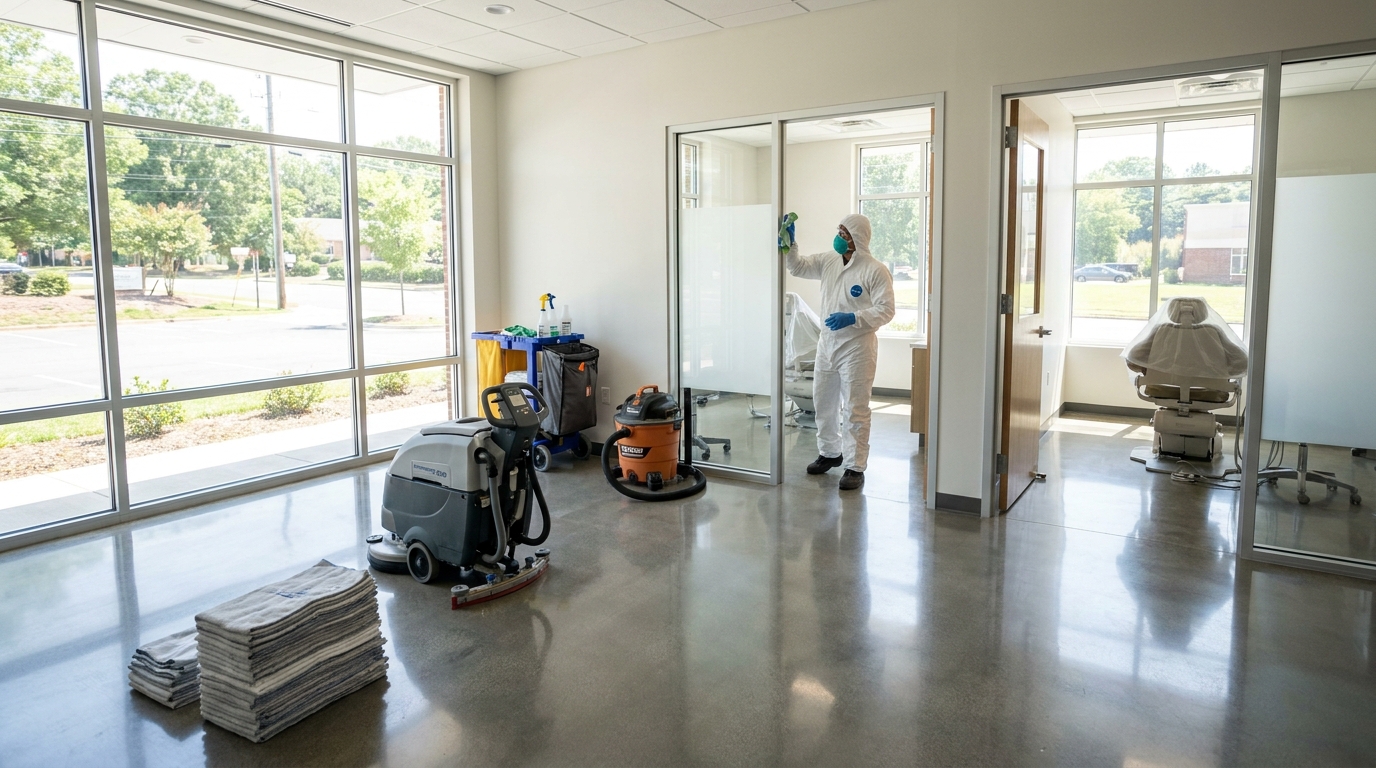
The final clean is the hand-off condition for the tenant walk-through. This is the phase most owners mean when they say "move-in ready," and it is also the phase that fails when someone treated the rough clean as the whole job.
A final commercial post-construction cleanup goes surface by surface, not zone by zone with a mop. Typical scope on a Carolinas office, medical, or retail build-out includes:
- Interior glass, sidelites, storefront, and vision panels, including the edges where film and paint overspray hide.
- Window film, adhesive dots, and manufacturer stickers on glass, fixtures, appliances, and hardware.
- Paint overspray on floors, base, glass, and electrical covers.
- Grout haze and thinset dust on tile, stone, and grout lines.
- Floor-protection adhesive, tape residue, and cardboard or Ram Board fibers ground into the finish.
- Inside cabinets, drawers, closet shelving, and the tops of upper boxes where drywall dust settles.
- Light-fixture interiors, lenses, and the dust ring around high hats.
- Supply and return covers, thermostats, and the face of equipment that ran during construction.
- Stainless, chrome, and plumbing trim, including aerators that collected grit.
- Door hardware, frames, and the top edge of doors that never got wiped.
- Elevator cabs, lobbies, and the path of travel the inspector will actually walk.
Glass is a common fail point. Construction film is designed to stay put through the job. It leaves adhesive, and the glass behind it often has overspray and silica-bearing dust. That is a window washing problem, not a spray-bottle problem. Floors are the other fail point. A new epoxy, VCT, or polished concrete floor that still has protection tape and haze will look dirty under walk-through lighting. That work belongs with a floor care process, not a nightly auto-scrubber run.
New materials also off-gas. EPA remodeling guidance recommends maximum ventilation during installation of paints, finishes, and flooring, and for at least 72 hours after that work is completed.[8] EPA's school-construction checklist makes the same 72-hour point for carpet, paints, furnishings, and other VOC-emitting products, and it recommends exhaust (pulling polluted air out) rather than simply opening a window.[5] A final clean does not replace a building flush-out, but it should not trap solvent residue under a coat of dirty mop water either. We sequence wet work after dust is actually out of the room.
Touch-up: the punch list that always appears
After the final clean, the GC, tenant representative, and often the architect walk the space. There is always a punch list. A painter comes back. An electrician swaps a device. A flooring installer recaulks a transition. Each return visit leaves fingerprints, dust, and sometimes a new round of overspray.
Touch-up is the third phase, not a favor. We stay engaged through the punch period to reclean the rooms that were reopened, pull remaining film, and restore the walk-through condition before the tenant takes occupancy. Quoting rough, final, and touch-up as separate line items keeps the GC's schedule honest. If punch work drags, the last clean is still defined, priced, and staffed.
This is also where occupied medical and office turnovers in the Charlotte metro, and across North and South Carolina, get missed. A clinic cannot open with grout haze in the restroom and construction dust in the exam-room supply grille. A professional office cannot sit a receptionist under a dusty return. NIOSH investigators looking at occupied-building renovations documented occupant complaints of headache, sinus problems, congestion, dizziness, nausea, fatigue, and eye, nose, or throat irritation when dust control, HVAC isolation, and communication were weak. In one office modernization they studied, workers were dry sweeping construction debris, which produced airborne dust, and poorly sealed polyethylene barriers let contaminated air move into occupied wings.[9]
Those are indoor-air failures, not cosmetic ones. The remedy is a documented punch-period reclean with HEPA equipment, not another pass by the building's night crew.
Dust control that belongs on a commercial job
Fine construction dust is the reason a post-construction crew is not interchangeable with janitorial staff. Gypsum, silica-bearing masonry dust, wood fines, and insulation fibers ride air currents, settle on horizontal surfaces, and resuspend when someone dry sweeps or uses compressed air.[6][9]
OSHA defines a HEPA filter as at least 99.97 percent efficient at capturing 0.3-micrometer particles. HEPA-filtered vacuuming is an example of a housekeeping method that minimizes employee exposure to respirable crystalline silica, and some construction tasks on OSHA Table 1 require it.[10] Breathing respirable crystalline silica can cause silicosis, an incurable lung disease, as well as lung cancer, COPD, and kidney disease.[11] Construction workers who cut, saw, grind, drill, or crush concrete, brick, block, and mortar generate that dust. Cleanup crews who later dry sweep the same rooms can put a portion of it back in the air.
Our post-construction cleanup scopes HEPA-filtered vacuuming for renovations and build-outs with dust-sensitive tenants, including medical offices, clinical labs, and food service. On occupied floors we expect the GC's containment to stay up until the final dust work is done. EPA is direct about isolation for high-dust jobs: a flap of plastic over a door is not enough for demolition-level dust. Isolation means the work area is sealed, with no direct access from occupied space, until cleanup is completed.[8]
We also treat HVAC as a finish, not as a vacuum. EPA tells contractors to temporarily seal return and supply vents and open ductwork during construction so debris and dust do not contaminate air handlers.[5] NIOSH recommends covering HVAC supply and return grilles in the construction area and surrounding hallways, and it warns against storing construction materials in mechanical rooms.[9] If dust has already entered the system, that is an HVAC cleaning problem, not something a mop bucket will fix. The post-construction crew's job is to stop adding to it.
What GCs and facility managers in the Carolinas should put in the spec
If you are bidding a new commercial building or a tenant renovation in North or South Carolina, write the cleaning as a three-phase specialty, not as "janitorial at turnover." A useful spec, in our experience, includes:
- A walk-through before the quote, so square footage is not the only number that matters. Finishes, occupied-adjacent work, and the real condition of the space drive labor more than floor area.
- Separate pricing for rough, final, and punch-list touch-up.
- HEPA-filtered vacuuming as the default method for fine dust, not dry sweeping.
- Explicit removal of stickers, film, grout haze, paint overspray, and floor-protection adhesive.
- Interior glass and specified exterior or storefront glass as a defined package.
- Floor care matched to the actual finish (strip and seal, burnish, or a first auto-scrub after protection comes up).
- Coordination with remaining trades so we are not cleaning in front of a painter who still has work left.
- A documented walk with the GC and tenant representative after the final clean.
We work around finish schedules. Trim carpentry, electrical, and HVAC commissioning are often still on site when we start. That is normal. What is not normal is asking the building's night janitorial crew to absorb construction residue on top of occupied-floor work. Those crews are staffed and equipped for an operating office, not for C&D debris, silica-bearing dust, or a punch list.
Pure Cleaning Solutions is commercial only. We do not do residential turnovers. We do quote one-time work for post-construction, move-outs, emergency disinfection, and specialty remediation. We send the same crews, keep documented logs, and walk the job before we quote. Our teams are bilingual, fully insured and bonded, and reachable 24/7. That is the operating model a GC can put on a schedule without wondering who will show up for the punch reclean.
Practical takeaways
- Buy three phases (rough, final, and touch-up), not a single "final clean" that has to absorb punch-list traffic.
- Treat construction debris as a C&D waste stream and a safety housekeeping issue, not as extra bags for the night crew.[2][3][4]
- Prohibit dry sweeping of construction dust. Specify HEPA-filtered vacuuming, especially where masonry, concrete, or drywall dust is present.[5][6][10]
- Keep barriers, sealed HVAC openings, and exhaust or negative pressure in place on occupied renovations until dust work is done.[1][8][9]
- Put stickers, grout haze, paint overspray, window film, and floor-protection removal in writing. Those items fail walk-throughs.
- Ventilate after paints, adhesives, and flooring go in. EPA's typical recommendation is maximum ventilation during installation and for at least 72 hours after.[5][8]
- Walk the space with the GC and tenant representative after the final clean, then schedule touch-up against the actual punch list.
How we can help
If you have a commercial build or tenant renovation wrapping up in North or South Carolina, we will walk the site with you, quote rough, final, and touch-up as separate phases, and staff the punch period so the space is actually move-in ready. Request a quote or call 980-419-5497. We bid from plans or from a job-site walk, and we coordinate around your finish schedule.
Citations
- U.S. Environmental Protection Agency, "Renovation and Repair, Part of Indoor Air Quality Design Tools for Schools" (updated 2026-06-23)
- U.S. Environmental Protection Agency, "Sustainable Management of Construction and Demolition Materials" (2018 data; page updated 2026-03-18)
- Occupational Safety and Health Administration, "29 CFR 1926.25 Housekeeping"
- Occupational Safety and Health Administration, "29 CFR 1926.252 Disposal of waste materials"
- U.S. Environmental Protection Agency, "Construction, Part of Indoor Air Quality Design Tools for Schools" (updated 2025-12-01)
- Occupational Safety and Health Administration, "Occupational Exposure to Respirable Crystalline Silica, 29 C.F.R. § 1926.1153, Construction FAQs" (housekeeping, paragraph (f))
- National Institute for Occupational Safety and Health, "Silica and Worker Health" (2026-07-07)
- U.S. Environmental Protection Agency, "Best Practices for Indoor Air Quality when Remodeling Your Home" (updated 2026-06-23)
- National Institute for Occupational Safety and Health, "Maintaining Acceptable Indoor Environmental Quality (IEQ) During Construction and Renovation Projects," DHHS (NIOSH) Publication No. 2020-110 (January 2020)
- Occupational Safety and Health Administration, "Small Entity Compliance Guide for OSHA's Respirable Crystalline Silica Standard for Construction," OSHA 3902-07R 2017 (HEPA definition and housekeeping)
- Occupational Safety and Health Administration, "Silica, Crystalline - Health Effects"