Electrostatic Disinfection After Workplace Illness
After flu, norovirus, or a similar illness has already circulated in a commercial workplace, extra wipes on the usual high-touch list are not the same as whole-room disinfection. Electrostatic disinfection is an application method for an EPA-registered disinfectant. It can coat more surfaces than a night crew can reach with cloths, and it only works if the product is labeled for that method and the surface stays wet for the labeled contact time.[1][2] CDC tells offices and other community facilities to clean high-touch surfaces regularly, and to disinfect where people have obviously been ill.[1] A documented one-time visit is warranted when illness has moved through staff or visitors. Nightly janitorial remains the baseline. It is not the substitute.
Extra wipes are not whole-room disinfection
Most office managers reach for more of what they already buy. The night crew gets a longer high-touch list. Someone puts a canister of wipes on the break-room table. That response treats the outbreak as a few extra doorknobs.
Illness does not stay on the list. People with influenza may transfer virus from contaminated surfaces to the face, and CDC still treats standard precleaning plus disinfectant at the labeled contact time as the environmental control for influenza in healthcare settings.[10] Norovirus is a harder environmental problem. CDC reports about 2,500 norovirus outbreaks in the United States each year, and the virus can persist on surfaces for days or weeks and is resistant to many common disinfectants.[6] Tiny drops of vomit can land on counters, chair backs, and objects well beyond the visible mess, and a person can still spread norovirus for 2 weeks or more after feeling better.[7]
CDC's facility guidance for offices, gyms, businesses, and community centers is plain. Clean high-touch surfaces regularly (pens, counters, door handles, stair rails, elevator buttons, touchpads, restroom fixtures, desks). Clean other surfaces when they are visibly dirty. Disinfect, in addition to cleaning, where people have obviously been ill, for example after vomiting on facility surfaces.[1] During outbreaks, local health authorities may also recommend specific disinfection procedures.[1]
A night pass that sprays a counter and wipes it dry is cleaning theater if the product never stayed wet long enough to match its label. Extra wipes help only on the surfaces the cloth actually touches, at the wet time the product actually needs. Shared keyboards, chair arms, partition edges, light switches, refrigerator handles, and the underside of a conference-table lip are easy to miss when the crew is still on a janitorial clock.
What electrostatic application actually does
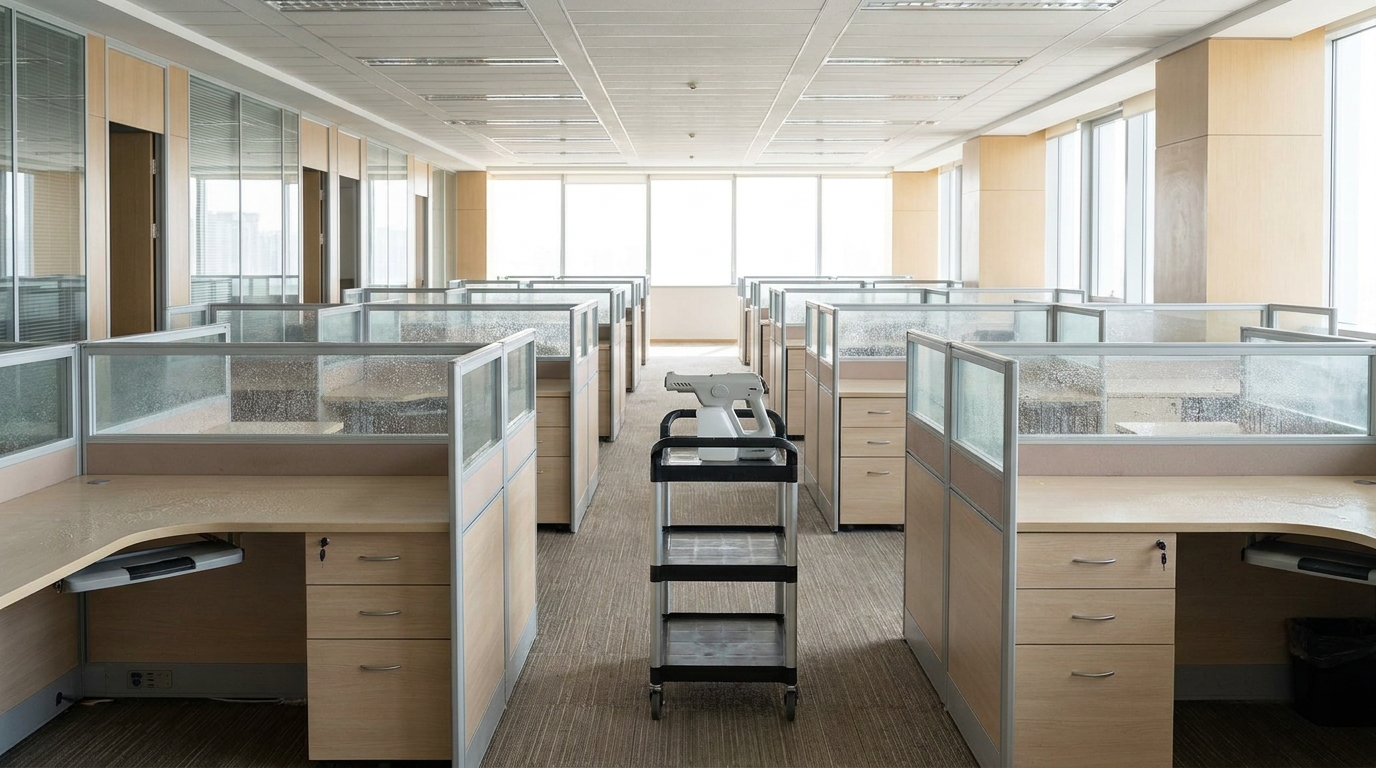
An electrostatic sprayer puts a charge on disinfectant droplets as they leave the nozzle. The charged droplets are meant to deposit more evenly on surfaces than an uncharged mist, which is why businesses have used the devices to treat large, frequently touched areas faster than wipe-only work.[2] EPA researchers evaluated that claim. Using less product can be an advantage and a failure at the same time: if the surface does not stay wet for the required contact time, the disinfection process may not work.[2] Manufacturers also advertise wrap-around coverage on complex objects. EPA found limited wrap-around, regardless of charge, in the sprayers it tested.[2]
That is the operator's version, not the brochure version. Electrostatic disinfection is not fogging a room and walking away. It is not a kill claim of its own. EPA is explicit that a sprayer is only as effective as the disinfectant being applied, and that only EPA-registered products should be used, in accordance with the product label.[3] CDC goes further for community facilities: in most cases, fogging, fumigation, and wide-area or electrostatic spraying are not recommended as primary methods of surface disinfection, and they carry safety risks, unless the product label says those methods can be used.[1]
The legal and practical test is the label. EPA registers disinfectants as pesticides and approves the label language, including which organisms the product may claim and how it may be applied.[4] If the label does not include directions for electrostatic spray, EPA has not reviewed safety and efficacy for that method.[4] If the label does not include the organism of concern, EPA has not reviewed data for that use.[4] The contact time is not a suggestion. The surface should stay visibly wet for the entire interval, and if it dries early the product needs to be reapplied.[4]
A 2020 study in the American Journal of Infection Control tested an electrostatic sprayer with a dilute sodium hypochlorite disinfectant on waiting-room chairs, portable equipment, and wheelchairs after minimal precleaning of visible soil.[9] Contamination with one or more of the pathogens cultured was present on 30% or more of those surfaces.[9] Spraying a waiting room with 15 to 20 chairs took about 5 minutes, and inoculated bacteriophage MS2 was not recovered after treatment.[9] The same paper is useful for what it does not promise. Curved and vertical surfaces often dried in about 2 minutes, which was shorter than the 5-minute wet time the product needed for Clostridioides difficile spores, and the authors did not expect spray to replace manual cleaning of items that can be wiped easily.[9] Coverage is the point. Dwell time is still the job.
Contact time still decides whether the product works
Facility managers often hear "hospital-grade" and stop there. The organism matters more. For norovirus, CDC tells people to clean the area first, then disinfect with a chlorine bleach solution of 1,000 to 5,000 ppm or with an EPA-registered product with a norovirus claim, and to leave bleach disinfectant on the affected area for at least 5 minutes before cleaning again with soap and hot water.[5] EPA List G is the agency's list of registered products with laboratory data against norovirus (tested with feline calicivirus as the surrogate). Contact times on that list vary by product and concentration, which is why the bottle in the cart has to match the organism, not a generic "sanitize" wipe from the supply closet.[8]
CDC's norovirus outbreak guidance for healthcare settings, which is still the most detailed environmental protocol published, tells facilities to clean surfaces before applying disinfectant, then follow manufacturer directions for dilution, application, and contact time with an EPA-approved product that has a norovirus claim.[11] It also tells them to increase cleaning of high-touch surfaces during outbreaks, and to work from lower-contamination areas toward toilets and other heavily soiled fixtures.[11] Those steps travel to a commercial office more cleanly than a clinic's isolation rules do. Preclean. Match the product. Hold the wet time. Do not drag a restroom cloth onto a break-room table.
Influenza is usually easier on surfaces than norovirus, which is why extra wipes feel like enough during a winter wave. CDC still describes the same sequence even in healthcare: cleaners and water to preclean, then disinfectant on frequently touched surfaces for the indicated contact time.[10] The sprayer does not shorten that clock. If the label says 10 minutes, a 30-second pass with an electrostatic wand is an application, not a completed disinfection.[4]
Soil is the other failure mode. Dirt and organic matter can block disinfectant from reaching the organism. CDC's facility page tells operators to clean surfaces before sanitizing or disinfecting them for that reason.[1] Visible vomit or diarrhea is not a spray-and-go event. It is a glove-and-absorbent-wipe event first, then disinfectant at the labeled wet time.[5]
When a one-time visit is warranted
Call for a dedicated disinfection visit when illness has already moved through the workplace, not only when a single person stayed home. Practical triggers in commercial offices, schools, and institutional buildings include:
- A cluster of gastrointestinal illness (vomiting, diarrhea) among staff or visitors, especially in shared restrooms, break rooms, or conference rooms.
- Confirmed or strongly suspected norovirus, or a winter wave of flu-like illness that has already jumped desks.
- A vomiting or diarrhea incident in a high-traffic area, where droplets and hand transfer can contaminate far more than the floor spot people can see.[7]
- Shared equipment and seating that a night crew cannot reasonably wipe on all sides (chair clusters, reception furniture, locker areas, training rooms).
- A manager who wants a documented refresh before reopening a floor, not another round of the same wipe list.
CDC defines a norovirus outbreak as two or more similar illnesses from a common exposure that is suspected or laboratory-confirmed as norovirus.[6] Close quarters, shared spaces, and high-touch surfaces are why schools and similar settings see spread quickly.[6] An office is not a cruise ship, and it is not a hospital ward. It is still a building where people share kitchens, restrooms, and door hardware. Sick-leave policy still matters. CDC tells food workers, school staff, and others who may expose people to norovirus to stay out of those roles for at least 48 hours after symptoms stop, because people remain contagious after they feel better.[5][7] Disinfection does not replace that.
A one-time visit is also the wrong tool in some cases. Recurring medical and dental office sanitization, with infection-control chemistry and a written schedule, is a different program. Hazardous-drug cleaning is another specialty entirely. And this is not crime-scene work, trauma cleanup, or hoarding remediation. Our disinfection page is commercial and institutional sanitization: preventative electrostatic programs, targeted high-touch disinfection, and post-illness workplace refresh.
Same-day scheduling is available for time-sensitive commercial disinfection in our metro service areas. That is a scheduling fact, not a medical outcome. The chemistry still needs its wet time after we leave the nozzle.
How this differs from nightly janitorial and from medical-office work
Nightly janitorial service is soil removal, restrooms, floors, trash, and a defined high-touch wipe on a recurring route. It is the work that keeps an office usable. It is not scoped, staffed, or timed as a whole-facility disinfection after illness has circulated. Asking the night crew to "hit it extra" usually means the same cloths, the same minutes, and the same surfaces, with a longer checklist taped to the cart. That is still janitorial. After a GI cluster, it leaves the undersides, the chair clusters, and the surfaces nobody wiped long enough.
Medical and dental offices are a third category. Those accounts need recurring infection-control protocols (EPA-registered hospital disinfectant at labeled contact time, color-coded tools, a written decontamination schedule), which we covered separately in why medical office cleaning needs different protocols. A post-illness electrostatic visit can support a clinic the same way it supports an office, but it does not replace that medical program. If your building is a law firm, a warehouse office, a school, or an institutional campus, this post is the closer match: one documented refresh (or a scheduled preventative program) on top of ordinary cleaning, not a rewrite of clinical housekeeping.
What a commercial disinfection visit should include
We treat electrostatic work as a scoped service, not a fog machine. A competent commercial visit should include, in writing:
- Scope. Facility type, areas, square footage, and goal (post-illness refresh, targeted high-touch, or scheduled preventative). Occupied versus vacant, and how long the space can stay unused while surfaces stay wet.
- Preclean. Visible soil, food residue, and body-fluid incidents removed first. Spray does not replace that step.[1][9]
- Chemistry matched to the organism. An EPA-registered hospital-grade disinfectant with a label claim against the organism of concern when it is known (norovirus on List G, influenza when that claim is on the label), and with electrostatic application on the directions for use.[4][8]
- Application that holds wet time. Electrostatic spray where the label allows it, plus hand application on surfaces that need it. Reapply if a vertical surface dries early.[2][4]
- Worker and occupant protection. Disinfectants are pesticides. NIOSH warns that many products used against viruses can harm workers if they are mixed, diluted, or applied incorrectly, and that users should follow the label, the required contact time, and the recommended protective equipment.[12] CDC tells employers to train workers, provide PPE from the safety data sheet, keep ventilation adequate, and follow OSHA hazard-communication rules that apply to the products on the cart.[1]
- Documentation. Product used, dilution if any, areas completed, crew, and timestamps. Facility managers need that log more than they need a scent.
We serve commercial and institutional facilities in North Carolina and South Carolina from our Matthews headquarters, with densest coverage in the Charlotte metro. Crews are bilingual (English and Spanish), fully insured and bonded, and we provide a free written quote within 24 hours. Photos of the space are often enough. A site visit is not required to quote.
Practical takeaways
- Extra wipes after workplace illness treat the surfaces a cloth can reach. They do not treat the rest of the room, and they fail if the product never stays wet for the labeled contact time.[1][4]
- Electrostatic disinfection is an application method, not a kill rate. Use an EPA-registered disinfectant with a claim against the organism of concern, and only use a sprayer if that method is on the label.[3][4]
- CDC does not treat wide-area electrostatic spray as a primary method in community facilities unless the label allows it. Preclean first. Hold wet time. Ventilate.[1]
- Norovirus is the case that most often outruns a wipe program: it persists on surfaces, resists many common disinfectants, and spreads from vomit droplets and hands, not only from the spot people can see.[6][7]
- Match chemistry to the organism. List G for norovirus. Follow the contact time on that product, not a generic "sanitize" claim.[5][8]
- Call for a one-time, documented visit when illness has clustered, after a vomiting or diarrhea event in a shared space, or when shared furniture and equipment cannot be wiped thoroughly on a night route.
- Keep nightly janitorial. Add disinfection. Do not confuse the two, and do not confuse a workplace refresh with medical-office protocol or specialty hazardous-drug work.
- Ask for the service log: product, crew, timestamps. If a vendor cannot tell you the contact time, they are selling a mist.
How we can help
If illness has moved through your office, school, or institutional building in the Carolinas, our team can scope a one-time post-illness refresh or a scheduled preventative electrostatic program using EPA-registered hospital-grade disinfectant, applied for coverage and dwell time, with a written service log. Same-day scheduling is typically available in metro service areas. Start with a free written quote at our contact page, review commercial disinfection and sanitization, or call 980-419-5497. We respond within one business day.
Citations
- CDC, "When and How to Clean and Disinfect a Facility" (2024-04-16)
- US EPA, "EPA Researchers Evaluate Electrostatic Sprayers for Disinfectant Application" (2021-07-13)
- US EPA, "Evaluating Electrostatic Sprayers for Disinfectant Application" (2021-02-19)
- US EPA, "Selected EPA-Registered Disinfectants" (2026-08-24)
- CDC, "How to Prevent Norovirus" (2025-01-13)
- CDC, "Norovirus Outbreaks" (2026-04-22)
- CDC, "How Norovirus Spreads" (2024-04-24)
- US EPA, "EPA's Registered Antimicrobial Products Effective Against Norovirus (feline calicivirus) [List G]" (updated 2026-06-03)
- Cadnum et al., American Journal of Infection Control, "Evaluation of an electrostatic spray disinfectant technology for rapid decontamination of portable equipment and large open areas in the era of SARS-CoV-2" (2020-08)
- CDC, "Infection Prevention and Control Strategies for Seasonal Influenza in Healthcare Settings" (2025-04-28)
- CDC, "Guideline for the Prevention and Control of Norovirus Gastroenteritis Outbreaks in Healthcare Settings: Summary of Recommendations" (page 2024-03-21; guideline 2011)
- NIOSH / CDC, "Hazard Communication for Disinfectants Used Against Viruses" (archived 2023-02-08)