Commercial Office Cleaning: Nightly Scope Before You Sign
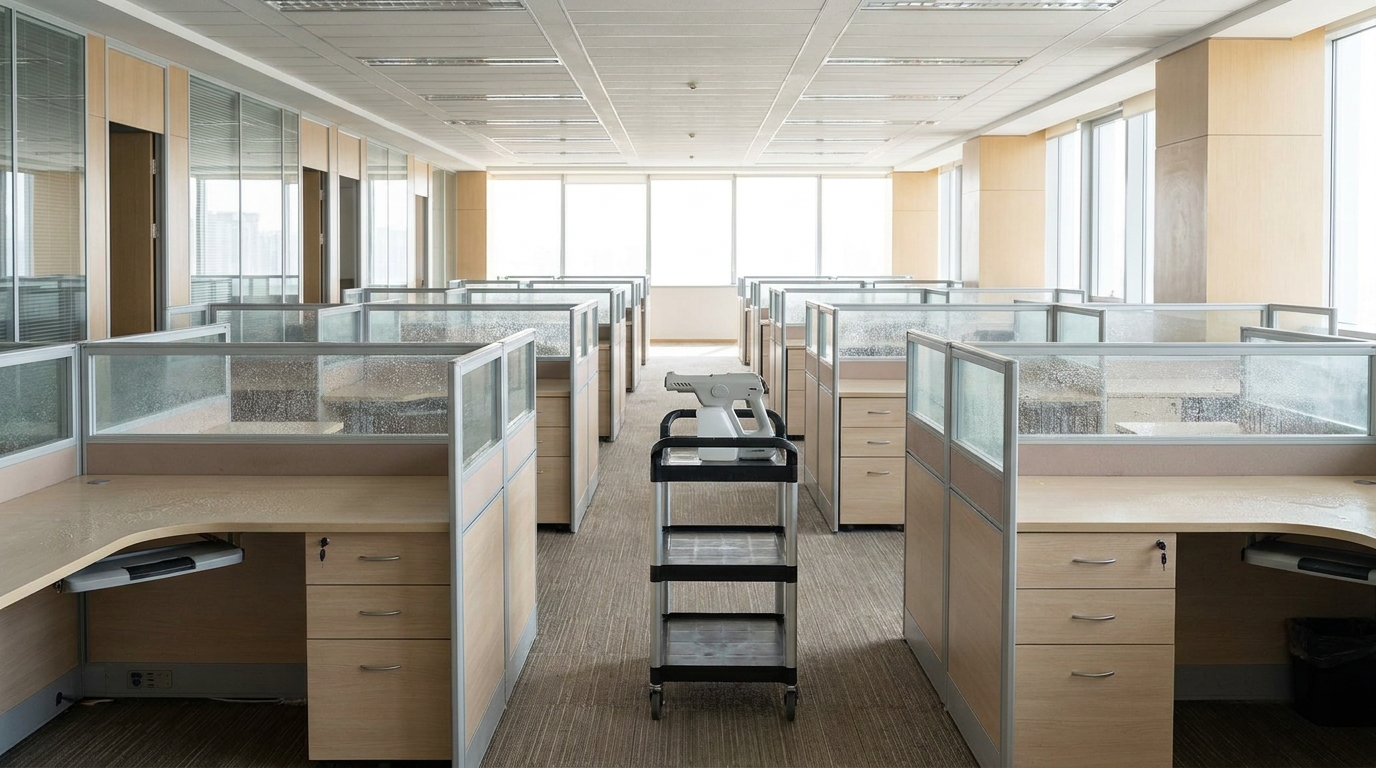
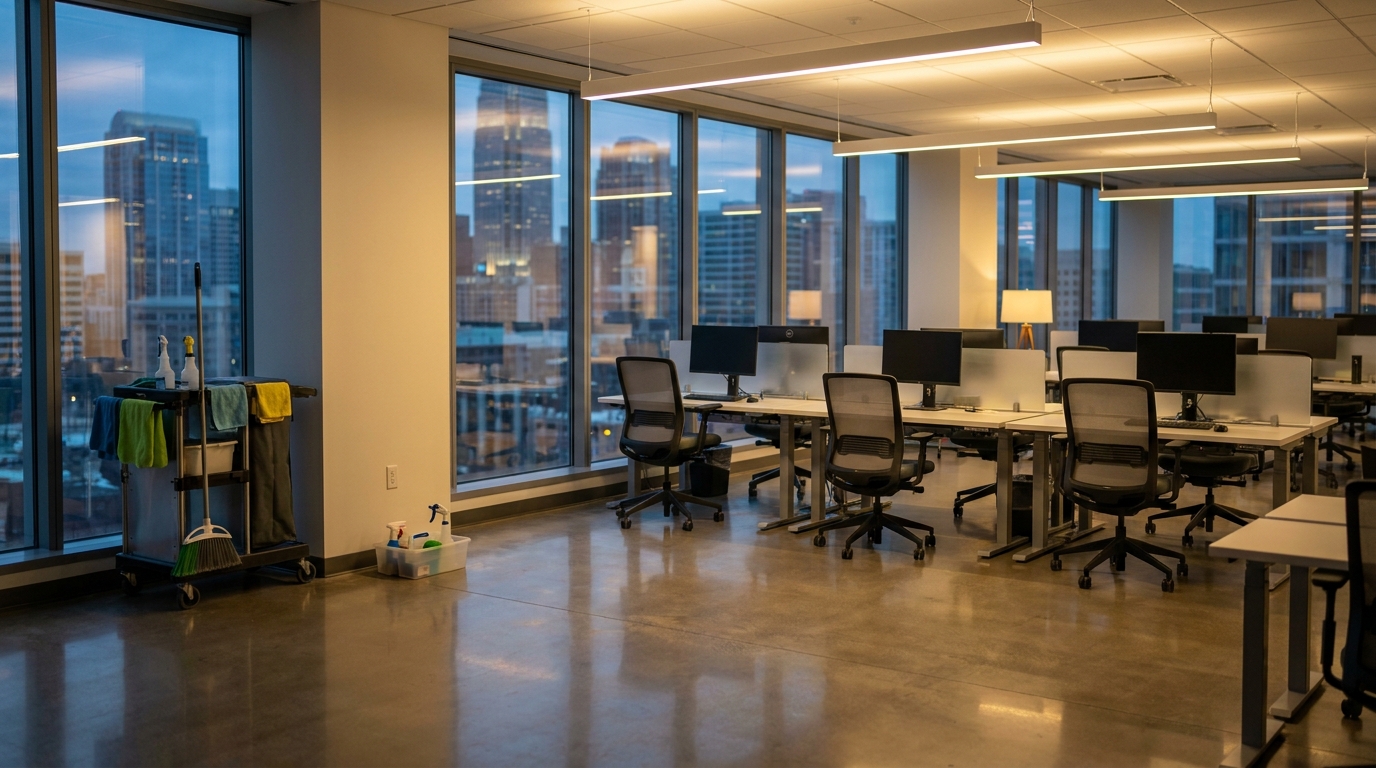
A real nightly commercial office cleaning program is a written list of rooms and tasks, not a square-foot price and a vacuum. Before you sign, the scope should name restrooms (fixtures, floors, and supplies), break rooms, high-touch surfaces, floor care, trash and recycling, and the after-hours practices the crew will follow when your staff is gone. The CDC's current guidance for offices and other community buildings is to clean high-touch surfaces regularly, clean other surfaces when they are visibly dirty, and disinfect where people have obviously been ill.[1] If a bid cannot show that list in writing, you are not comparing the same job.
Start with rooms, not square footage
Office managers in Charlotte and across North Carolina and South Carolina still see proposals that look complete until the first month of service. The cheap version is almost always the same: empty the cans, run a vacuum down the main aisle, and leave. Restrooms, pantries, door hardware, and kitchen counters are either "as needed" or missing. That is how a lower number wins the bid and how the space looks tired by Wednesday.
OSHA's sanitation standard for permanent workplaces requires more than a tidy appearance. Places of employment must be kept clean to the extent the work allows, waste must be removed often enough to stay sanitary, washing facilities must be maintained in a sanitary condition, and food-waste receptacles in eating areas must be emptied at least once each working day unless unused.[2] Walking-working surfaces, including office floors, passageways, and service rooms, must be kept in a clean, orderly, and sanitary condition, and workroom floors must be kept clean and, to the extent feasible, dry and free of spills.[3] Those rules sit on the employer. The nightly contractor is how most offices meet them. If the contract never names the rooms, you have no one to hold to the condition.
We write the rooms first. Workstations and common areas, restrooms, kitchens and break rooms, glass and touchpoints, and the floor program all go on the page. Frequency, products, and what the crew will not do (moving papers, emptying personal food without permission, unplugging equipment) go on the same page. A verbal "we do it all" is not a scope.
Restrooms: fixtures, floors, and supplies every night
Restrooms fail first when a bid is too thin. OSHA requires toilet rooms, washing facilities with hot and cold (or tepid) running water, soap or a similar cleanser, and towels or another drying method, and those washing facilities must be kept sanitary.[2] That is a condition standard, not a minute-by-minute clock. In practice, a nightly office program is how a typical office holds that condition overnight.
University facilities programs are a useful check on what "daily restroom" actually means. Colorado State University's May 2025 custodial frequencies call for emptying and relining restroom trash daily, disinfecting sinks, toilets, urinals, and tubs daily, disinfecting toilet-paper dispensers and partitions daily, and sweeping and mopping restroom floors daily.[4] Oakland University's published restroom list is the same idea: toilets, sinks, urinals, partitions, wastebaskets, floors, paper stock, and soap dispensers, all daily, plus reporting needed repairs.[5] A commercial office is not a campus, but if a vendor's nightly restroom line is "wipe sinks," it is not a restroom program.
CDC lists restroom fixtures among the high-touch surfaces that should be cleaned regularly in community buildings such as offices.[1] That is the nightly work: bowls, seats, flush handles, faucets, stall hardware, dispensers, mirrors, floors, and restock. Supply management belongs in the same visit. Empty soap or paper is not a cleaning complaint. It is a missed task.
Norovirus is the reason restrooms cannot be the first cut. CDC states that norovirus spreads through contaminated surfaces when a sick person touches them, when contaminated objects are placed on them, or when vomit or diarrhea reaches them, and that you can still spread the virus for 2 weeks or more after you feel better.[6] After someone vomits or has diarrhea, CDC directs an immediate clean-and-disinfect of the area with an EPA-registered product effective against norovirus (or a bleach solution mixed to the concentrations on that page).[7] That response is not the nightly restroom list. It is the reason the nightly list has to be real, so the room is not already dirty when an illness event happens.
If the space is a clinic, exam room, or other medical setting, stop. That is a different protocol, not a heavier version of this checklist. We cover that distinction separately in why medical office cleaning needs different protocols. This post is the standard office floor.
Break rooms: food-contact surfaces, not just the can
Break rooms are where offices grow odors, pests, and complaints. OSHA does not allow food or beverages in toilet rooms, requires easily cleanable food-waste receptacles that are emptied at least once each working day unless unused, and requires employee food service on the premises to follow sound hygienic principles.[2] The same sanitation standard also requires a continuing vermin-control program where rodents or insects are found.[2] Leftover food on counters and in overflowing kitchen cans is how that problem starts.
Federal custodial specifications treat tenant break rooms with restrooms as rooms that get more than a trash pull. GSA's national consolidated custodial performance work statement requires those rooms to be cleaned and disinfected with EPA-registered products (or equivalent active ingredients), and it requires food-contact surfaces such as tenant break-room counters and dining tables to be cleaned and sanitized with products safe for food contact.[8] Dispensers in tenant break rooms are replenished as a standard service in that specification.[8] You do not have to be in a federal building for that logic to apply. If people eat there, the counters, tables, sink, faucet, appliance exteriors, and the floor are part of the nightly job.
Our kitchen and break-room detail follows that pattern: appliance exteriors, counters, pantry tidy, and fridge rotation on a schedule you approve. We do not empty old tupperware without permission. Personal food in a labeled container is not "trash" because a cleaner opened the door. Put fridge rules in the written scope so the crew is not guessing and so your staff is not surprised.
EPA's indoor-air guidance for offices also treats housekeeping and food storage as occupant and management work, not as extras. The agency's office-occupant guide (posted as a 2014 web publication, last updated in 2026) tells occupants to dispose of garbage promptly, store food properly, clean refrigerators on a regular basis, and keep kitchens and dining areas clean and sanitized as necessary to prevent pests.[9] Nightly commercial office cleaning is the contractor side of that list.
High-touch surfaces: name them, or they will not get done
"Wipe touchpoints" is not a task. CDC's examples for community settings include pens, counters, door handles, stair rails, elevator buttons, touchpads, restroom fixtures, and desks.[1] In an office, add light switches, copier panels, conference-table edges, reception counters, and the glass around the entry. If those items are not named, a rushed night will skip them.
CDC is also clear that cleaning and disinfecting are not the same thing. Cleaning with soap or detergent reduces germs on surfaces. Sanitizing reduces remaining germs after cleaning. Disinfecting can kill remaining germs after cleaning. In most community situations, regular cleaning is enough. Disinfect in addition where people have obviously been ill, or in high-traffic areas if you choose to, and use an EPA-registered product for the germ in question, with the full contact time on the label.[1] EPA's greener-cleaning guidance makes the same split: limit disinfectant use to areas where people are likely to contact contaminated surfaces (bathroom fixtures, doorknobs, other high-touch surfaces). Many general-purpose tasks, such as walls and floors with little hand contact, do not typically require a disinfectant.[10]
That matters for indoor air as well as for germs. EPA notes that people spend 90 percent of their time indoors, and that indoor levels of some pollutants are often several times higher than outdoors.[11] Cleaning products themselves can add to that load. EPA states that volatile organic compounds in cleaning products can affect indoor air quality, and that janitorial staff can be exposed to concentrated products without training and chemical management.[10] Safer Choice-certified products are available for offices, and the program restricts VOC content specifically to reduce indoor air pollution and related respiratory concerns.[12] A written scope should say which products are used on desks, food-contact counters, and restroom fixtures, and that Safety Data Sheets stay on site.
Floors: nightly work is not restoration
Floors are the walking-working surfaces OSHA expects to stay clean, orderly, sanitary, and, where feasible, dry, and free of spills and other hazards.[3] Nightly floor care in an office is vacuuming traffic lanes and workstations, mopping hard floors, and treating spots. Entry mats belong in that visit when weather tracks in water and grit, because wet soil at the door becomes a slip problem and a carpet problem ten feet later.
GSA's custodial specification schedules disruptive work (vacuuming, carpet shampooing, floor waxing) for vacant space or after normal operating hours, and it requires a floor-maintenance schedule that separates routine, periodic, and restorative tasks.[8] That split is the one office managers should copy. Nightly mopping keeps the floor. Rotational deep cleans keep the finish from going dull. Buffing, stripping, and waxing are a different visit when you ask for them. Do not let a bid bury restoration inside "floor care" and then never schedule it, and do not pay restoration prices for a nightly mop.
Industry workloading exists so this labor is not guessed. ISSA's Official Cleaning Times is the long-running reference service providers use to estimate how long named tasks take and to staff a building from those tasks rather than from a round number.[13] We are not an ISSA member, and membership is not the point. The point is that restrooms, kitchens, and obstructed workstations take time that open carpet does not. A bid that ignores that math will drop the rooms you notice first.
Trash, recycling, and what leaves the floor
Trash is the visible proof a crew was there, which is why thin programs do it and little else. OSHA still sets the bar: waste receptacles for putrescible waste must not leak and must be keepable in a sanitary condition, and all sweepings, refuse, and garbage must be removed in a way that does not create a health menace, as often as needed to keep the workplace sanitary.[2] In eating areas, that frequency is at least once each working day unless the can went unused.[2]
A nightly office scope should say which cans get emptied (desk-side, kitchen, restroom, copy room), that liners are replaced when soiled or torn, and where bags go in the building's waste program. Recycling is the same visit, not an optional add-on that "the day porter might get." Compostable streams, where the building has them, need a named handling note so food-soiled bags do not sit in a suite over a weekend.
Workstations, glass, and common areas
Desks, conference tables, reception, and shared rooms are the rest of the floor. CDC includes desks among high-touch examples, and it tells facilities to follow manufacturer instructions on electronics such as keyboards and touch screens.[1] Our standard office scope covers workstations and common areas on the agreed schedule, including glass partitions and high-traffic zones, without turning the visit into a paper hunt. Cabinets and desks with papers, computers, and keyboards should not be disturbed. That rule belongs in the scope so a new cleaner does not "straighten" a working pile.
Glass at entries and on interior partitions shows streaks in daylight. If glass is not on the nightly or weekly line, it will wait until someone complains. Name the glass, the height, and the frequency.
After-hours practices that belong in the contract
Nightly work happens when the floor is empty. That is the point, and it is the risk. A scope that ignores security is incomplete even if the restrooms look good.
GSA's custodial specification is a clear model for the paperwork, even for a private office in the Carolinas. Contract employees sign in on arrival and sign out on departure, follow card-access rules, display credentials while in the building, and return those credentials when they leave the account. Temporary workers without a completed suitability check are escorted. Papers on desks stay put. Government (or, in a private suite, tenant) equipment is not unplugged or adjusted.[8] Disruptive equipment runs when the space is vacant.[8]
Translate that into what you should require before you sign:
- Named, background-screened people, not a rotating list of whoever is free. We use W-2 crews and background screening. Shared door codes and unlabeled keys are how access spreads past the people you approved.
- A visit log for every night: who was there, what was completed, what was short, what needs a repair ticket (overflowing drain, broken dispenser, leak).
- Uniforms or credentials visible in the building.
- Lights and faucets off in empty rooms, HVAC controls left alone, no unplugging of tenant equipment.
- A way to reach someone if the crew finds a door unlocked, a leak, or an alarm. We run 24/7 emergency response for those calls. That is not a promised arrival time for a cleaning visit. It is a live phone when something is wrong after hours.
Ask how keys and badges are issued, stored, and pulled when a cleaner leaves the account. If the answer is "we use the code the last vendor used," keep shopping.
How to tell a real scope from a cheap bid
Put the two proposals next to each other and ignore the monthly number for a minute. Count named rooms. Count named fixtures. Look for restock, not just "clean restrooms." Look for food-contact language in the break room. Look for a high-touch list that uses door handles, elevator buttons, and switches, not "wipe as needed." Look for vacuum, mop, and spot treatment as nightly work, with restoration on a separate line. Look for visit logs and a monthly walk-back so the scope does not drift.
CDC's office guidance is not a healthcare protocol, and it says so on the page.[1] If a vendor is selling you hospital-grade disinfection for a standard office every night, ask why. If they are selling you trash-and-vacuum for a floor with two restrooms and a kitchen, you already know why the price is lower.
We have done commercial-only work from Matthews, North Carolina, for more than twenty years. We do not clean private residences, and we do not sell one-time general office cleaning. Recurring service is the model, because the rooms in this checklist only stay right if someone is there on a schedule. Walk-throughs are free and take about 20 minutes. You can also get a free written quote within 24 hours with no site visit required. The quote should read like the list in this post, written for your floor, not like a flyer.
Practical takeaways
- Require a written nightly scope that names restrooms, break rooms, high-touch surfaces, floors, trash and recycling, glass, and after-hours access rules before you compare price.
- Treat restrooms as a fixture, floor, and supply program. Empty soap or paper is a missed task, not a supply "issue."
- Put food-contact counters, appliance exteriors, and fridge rules in the break-room line. Do not let "kitchen" mean the trash can only.
- Name the touchpoints (handles, switches, elevator buttons, restroom hardware, reception counters). "Wipe touchpoints" will be skipped.
- Keep nightly vacuum and mop separate from strip-and-wax or other restoration. Restoration is a different visit.
- Require sign-in, visible ID, background-screened W-2 crews, visit logs, and a rule that papers and powered equipment are not disturbed.
- If the space is a clinic, use the medical protocol, not this office checklist.
How we can help
If you manage an office in the Charlotte metro or elsewhere in North Carolina or South Carolina, we will put this checklist into a written scope for your floor. See what our commercial office cleaning program includes, then request a quote. Walk-throughs are free. The quote is written. You will know what is on the list before you sign.
Citations
- Centers for Disease Control and Prevention, "When and How to Clean and Disinfect a Facility" (2024-04-16)
- Occupational Safety and Health Administration, "29 CFR 1910.141 Sanitation" (current)
- Occupational Safety and Health Administration, "29 CFR 1910.22 Walking-Working Surfaces, General Requirements" (current)
- Colorado State University Facilities Management, "University Cleaning Standards and Frequency" (2025-05-01)
- Oakland University Facilities Management, "Custodial Task Frequencies" (2026)
- Centers for Disease Control and Prevention, "How Norovirus Spreads" (2024-04-24)
- Centers for Disease Control and Prevention, "How to Prevent Norovirus" (2025-01-13)
- US General Services Administration, "National Consolidated Services Performance Work Statement" (2024-12-05)
- US Environmental Protection Agency, "An Office Building Occupant's Guide to Indoor Air Quality" (page last updated 2026-03-18; web publication dated 2014-08-28)
- US Environmental Protection Agency, "Identifying Greener Cleaning Products" (live page, 2026)
- US Environmental Protection Agency, "Factsheet: What is Indoor Air Quality?" (2025-07)
- US Environmental Protection Agency, "Learn About the Safer Choice Label" (live page, 2026)
- ISSA, "The Official ISSA Cleaning Times" (2025-09-05)