Commercial Floor Stripping and Waxing vs Nightly Mop
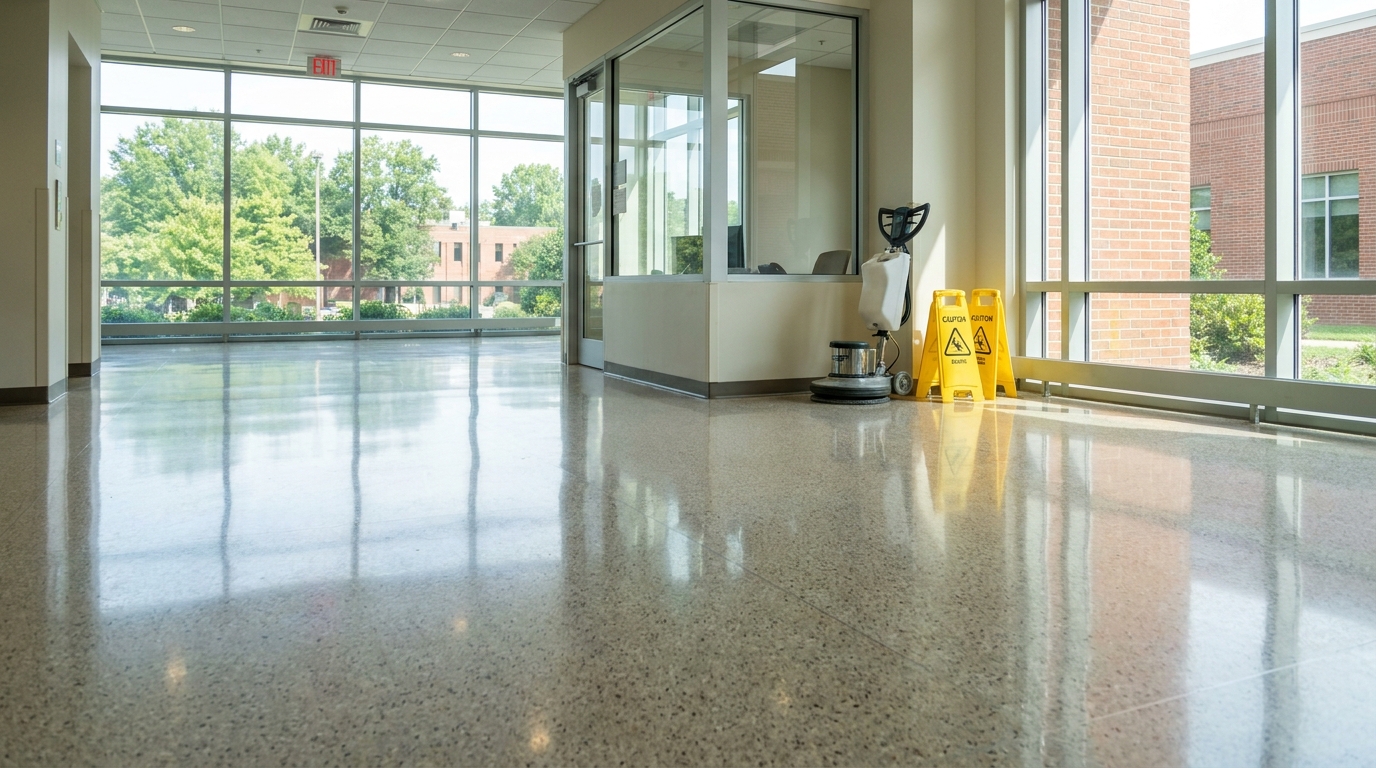
A corridor that looks acceptable after last night's mop is not proof the floor is protected. Once the finish film on vinyl composition tile (VCT) is worn, yellowed, powdering, or worn through in traffic lanes, commercial floor stripping and waxing is the restoration step, not another pass with a mop. OSHA requires walking-working surfaces to be kept in a clean, orderly, and sanitary condition, and to be inspected regularly and maintained in a safe condition.[1] Nightly mopping still belongs in the program. It removes soil. It does not rebuild a sacrificial finish that has already failed.
Nightly mopping is soil control, not finish restoration
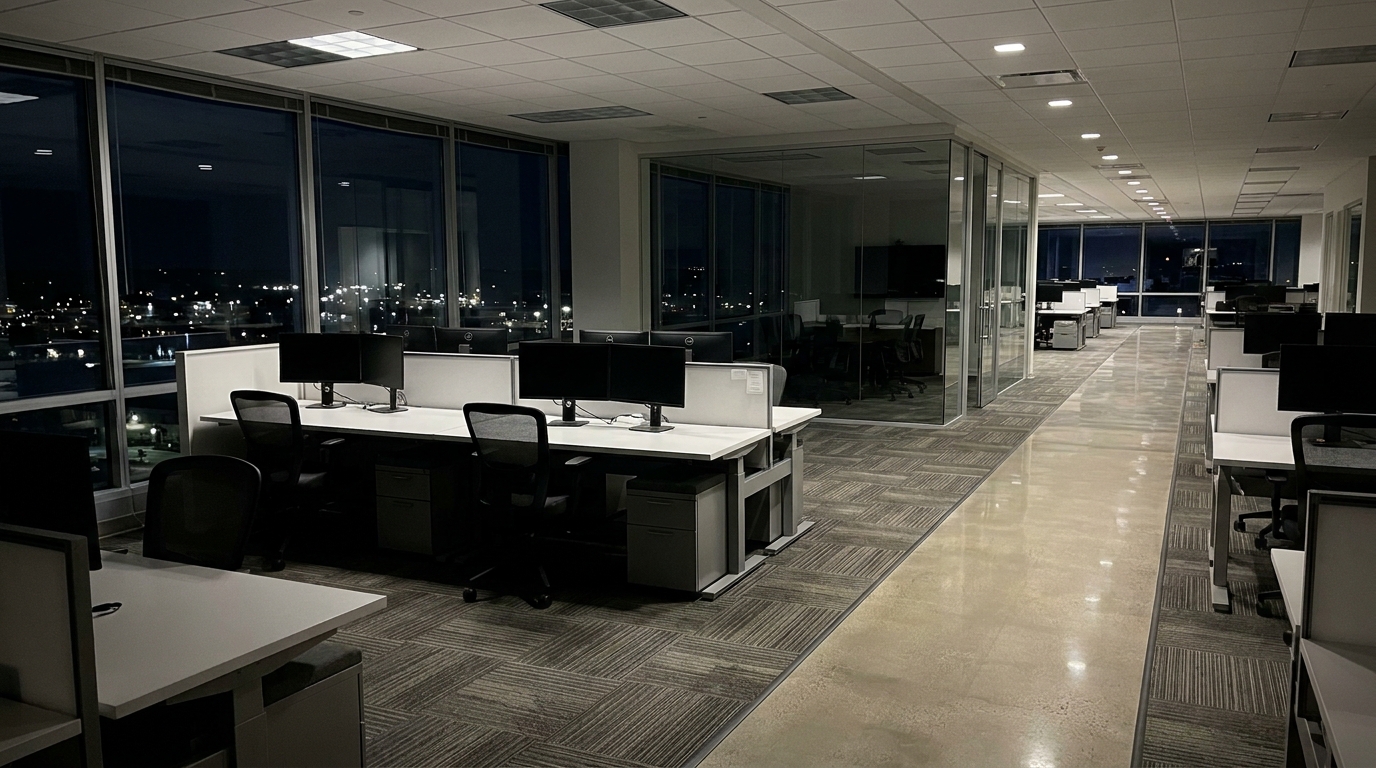
Most office and medical-building routes "do floors." Crews dust mop or vacuum, wet mop the hard surfaces, and move on. That is the right daily job. ISSA's 2022 guidance on cleaning times treats mopping as a measurable production task (its Official ISSA Cleaning Times & Tasks even publishes a floor-care mopping rate, for example 1,000 square feet with a 14-inch flat mop in about 11 minutes as a benchmark).[2] Daily work is supposed to be fast, repeatable, and documented.
The problem starts when that same mop is asked to fix a finish that is no longer doing its job. Commercial VCT is designed to be maintained with polish. Armstrong Flooring's current commercial VCT instructions call for damp mopping with a properly diluted cleaner, machine scrubbing when soil is heavy, and, when a sufficient base of polish remains (it specifies 3 to 5 coats), buffing, spray buffing, or burnishing to restore gloss. Restorative work is a separate procedure: strip the existing polish, rinse, dry, and apply 3 to 5 new coats.[3]
Once that film is thin, porous, or contaminated, a mop does not lift soil off a sealed surface. It redistributes it. CDC's environmental services guidance (still published on CDC's site as of 2024, drawn from the 2003 Guidelines for Environmental Infection Control in Health-Care Facilities) notes that bucket solutions become contaminated almost immediately during cleaning, and continued use of that solution transfers increasing numbers of microorganisms to each subsequent surface.[4] Dirty mop water on a worn finish is not a deep clean. It is a smear.
That is why we treat floor care as its own scope, not a footnote on a janitorial services route. Daily mopping and a scheduled strip, recoat, or burnish are different tasks, with different machines, chemistry, and downtime.
How to tell the floor needs more than a mop
You do not need a gloss meter to see a failing finish. Walk the building at the end of a normal day, in the light occupants actually use, and look for these signs.
Traffic lanes that stay dull after mopping. Main corridors, elevator lobbies, and the path from the waiting room to the exam suite take the grit. If those lanes stay gray or matte while the edges still look coated, the top of the film is gone. Armstrong's instructions are explicit: if enough polish remains, buff, spray buff, or burnish. If the floor is badly soiled or scratched, strip it.[3]
Yellowing, dark edges, and uneven buildup. Old finish oxidizes. Stripper residue, dirty rinse water, and coats stacked on dirty floors yellow at the baseboards while the field wears away. That is not a "needs more mop" problem. That is a full strip.
Powdering. A chalky dust that reappears after you dust mop is often failed finish, not ordinary soil. Burnishing a powdering floor usually makes it worse.
Bare tile in the lanes. Unprotected VCT soaks up soil. Once pigment and dirt are in the tile, no amount of mopping brings the color back. Restoration then costs more, and the tile may stay stained.
A floor that feels tacky or slick. OSHA's walking-working surfaces rule requires floors to be maintained clean and, to the extent feasible, dry, and kept free of hazards such as spills.[1] A degraded finish holds residue. A freshly mopped worn floor can be the slipperiest version of that floor. OSHA's hospital housekeeping eTool flags slips, trips, and falls on wet floors during the housekeeping process itself, and it tells employers to keep floors clean and dry and to clean one side of a passageway at a time so people still have a dry path.[5] Falls from heights and on the same level are among the leading causes of serious work-related injuries and deaths, which is why OSHA updated those walking-working surface rules.[6]
Walk-off mats that are doing all the work, and failing. Armstrong recommends walk-off mats at every entrance to control grit and soil, and regular cleaning of those mats.[3] If grit is grinding the finish 20 feet inside the door, the matting program and the floor program are both behind.
If two or three of those signs are present in a medical waiting room or an office corridor, schedule an inspection. Do not wait for a tenant complaint or a slip.
Strip and wax, scrub-and-recoat, and burnish are not interchangeable
Facility managers often use "wax the floors" as a catch-all. In the field, three different jobs get mixed together. Mixing them up either wastes a weekend or leaves the floor looking the same on Monday.
Burnish (and spray buff) is interim maintenance. A high-speed machine smooths and re-glosses a finish that is still intact. Armstrong lists buff, spray buff, or burnish as the step when a sufficient base of polish remains.[3] CDC's environmental services chapter also lists spray buffing among methods used on non-porous floors, along with wet mopping and wet vacuuming, and it prefers methods that produce minimal mists, aerosols, or dust in patient-care areas.[4] Burnishing a dirty floor, or a floor with no film left, just polishes the dirt.
Scrub-and-recoat is the middle option. A rotary machine or auto scrubber (Armstrong specifies 300 rpm or less for this class of work) deep-scrubs the surface, you rinse, and you add fresh coats on top of a sound base instead of taking the floor to bare tile.[3] Use it when traffic lanes are tired but the edges are not yellowed, peeling, or built up into ridges. It is less downtime than a full strip, and it is the job we use to stretch the interval between restorations.
Strip and wax (more accurately, strip and refinish: modern commercial finishes are polymer films, not household paste wax) is the reset. The crew applies stripper, keeps it wet for the labeled dwell time, agitates it with a low-speed machine, picks up the slurry, rinses, lets the floor dry, and lays down multiple thin coats. Armstrong's restorative procedure matches that sequence: mix to the right dilution, cordon the area, keep the solution wet, machine-scrub at 300 rpm or less, wet-vac or mop the slurry, rinse with fresh water, dry, then apply 3 to 5 coats of commercial polish.[3] Armstrong also warns against flooding the floor and against aggressive mop-on, no-scrub, no-rinse strippers on tile less than two years old, because they can affect the adhesive bond.[3]
How often? There is no single calendar that fits every lobby. Armstrong's 2024 VCT environmental product declaration models three traffic intensities. In that modeled year, stripping and refinishing happens once (low), twice (medium), or four times (high), with damp mopping and scrubbing or spray buffing filling the months in between.[7] Treat that as a manufacturer's planning range, not a contract. A quiet professional office may live on an annual strip plus recoats. A busy medical corridor may need more frequent restoration, or more frequent burnish and recoat so you are not stripping four times a year out of habit.
Site-applied finishes also change the walking surface. Armstrong's same 2024 declaration notes that VCT is tested for static coefficient of friction under ASTM D2047 / UL 410, and that site-applied sealers, polishes, and other finishes used to maintain resilient flooring will change that walking surface and the friction value.[7] That is one more reason the finish program belongs in writing, with products matched to the floor, not improvised from whatever is in the janitor closet.
Medical waiting rooms and office corridors are not the same job
We clean both. The finish program is related. The infection-control story is not.
CDC is cautious about floors as an infection vector, and we follow that caution. Its environmental services guidance classifies floors as housekeeping surfaces with infrequent hand contact, and it states that extraordinary cleaning and decontamination of floors in health-care settings is unwarranted. Studies it cites found that disinfecting floors offered no advantage over regular detergent-and-water cleaning and had minimal or no impact on health-care associated infections. Newly cleaned floors also become recontaminated quickly from air, shoes, and wheels.[4] CDC's 2024 procedure summaries for general patient areas say the same thing in plainer language: floors in general inpatient and outpatient areas have low patient exposure, pose a low risk for pathogen transmission, should be cleaned at least daily (neutral detergent and water, last after other surfaces), and may need disinfectant only based on the risk level of a specific area.[8]
So we do not sell strip and wax as a disinfection event. In a medical building, the case for restoration is still strong: a sound, intact finish is easier to damp-mop, holds less soil in the lanes, looks like a clinic instead of a worn back hall, and is less likely to stay wet and slick after routine cleaning. Waiting rooms, public toilets, and corridors still need daily floor work. CDC's 2024 summaries call for at least daily cleaning of waiting and admission floors, and more frequent, more rigorous work in higher-risk rooms.[8] Blood or body-fluid spills are a different protocol (clean, then disinfect, immediately), not a reason to skip the finish program.[8]
Office buildings are simpler on the infection side and just as demanding on appearance and slip. CDC's 2024 community-facility guidance (offices, gyms, businesses, and similar spaces, not health care) says to clean high-touch surfaces regularly and other surfaces, including hard floors, when they are visibly dirty, using soap and water or products appropriate for the surface.[9] Visible soil in a law-office corridor is a finish and traffic problem. It is also a client-facing problem. EPA's indoor-air guidance for schools, which applies the same materials logic to other public buildings, notes that furnishings and floorings can emit VOCs, and that resilient flooring is commonly specified in high-traffic areas where spills are likely.[10] A floor program that uses labeled products, rinses stripper thoroughly, and ventilates during restoration is part of keeping that indoor environment under control, not an extra.
OSHA's hazard communication standard still applies wherever we use stripper, finish, or disinfectant. Labels, safety data sheets, and worker training are not optional because the work happens after hours.[11]
What a recurring commercial floor program looks like
A one-time emergency strip after a tenant walkthrough is the expensive way to buy a floor. A written program is cheaper over a year, and it is the only way to keep medical and office floors consistent instead of cycling between dull and glossy.
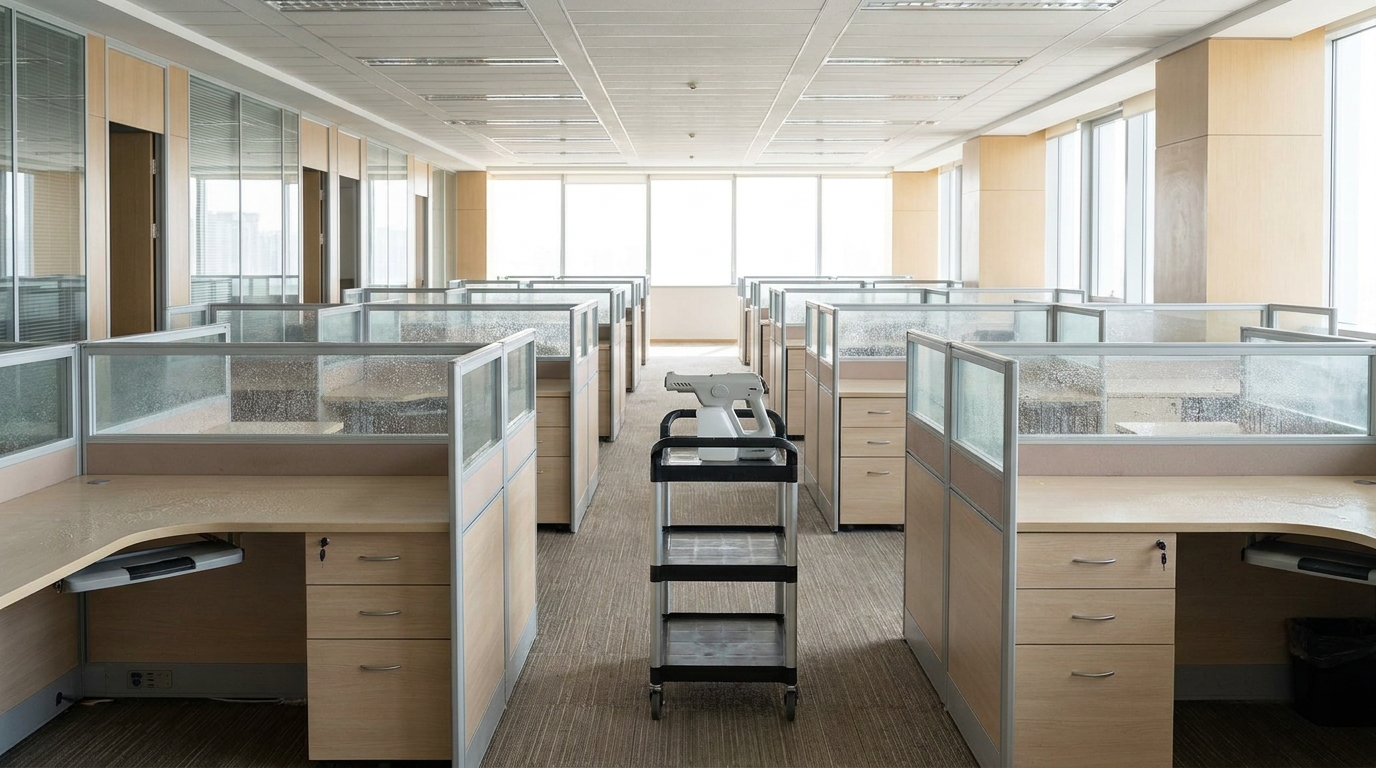
We start with a floor inventory: VCT, LVT, polished concrete, terrazzo, ceramic, commercial carpet. VCT is the classic strip-and-wax substrate. LVT, concrete, and terrazzo often need different chemistry and machines. Mixing them on one "wax night" is how finishes fail. Our floor care scope covers hard-floor strip and wax, polish, buff, burnish, deep scrub, and carpet extraction as separate services, not one generic mop.
Then we set the cadence against traffic, not against a brochure.
- Daily (or each service night): dust mop or vacuum grit, damp mop or auto-scrub with a neutral cleaner compatible with the finish, spot-treat spills. This is the janitorial layer. ISSA's production-rate method is how we think about labor: task, tool, time, square footage, and training, not "mop until it looks okay."[2]
- Periodic: burnish or spray buff high-traffic lanes while the film is still there. Auto-scrub heavy soil before it grinds in. Clean walk-off mats so they actually capture grit.[3]
- Interim restoration: scrub-and-recoat before the lanes wear to bare tile. This is the most skipped step we see, and the one that prevents emergency strips.
- Restorative: full strip and refinish when the film is yellowed, powdering, peeling, or worn through. After-hours or weekend work, wet-floor signage, one side of a corridor at a time where the building cannot close.[5]
- Cure time: coats dry between applications. Furniture and traffic stay off until the finish can take them. We do not invent a universal hour count. We follow the finish label and the building's access rules.
Medical accounts get the same crews and documented logs. That matters more than a one-night shine. If a clinic needs to show what was done in a waiting room last quarter, the log should say strip, neutralize, coats applied, or recoat only, not "floors done." The same is true in office towers. A property manager who can point to a written annual program (which floors, which service, which cadence) is not buying surprise quotes mid-year.
Carpet is the contrast, not the thesis. Vacuuming rearranges dry soil. Extraction pulls it. Hard-floor mopping rearranges wet soil on a failed film. Strip, recoat, and burnish are how you stop asking the mop to do restoration.
Practical takeaways
- Treat nightly mopping as soil removal. If traffic lanes stay dull, yellow, powdery, or bare after a good mop, the finish is spent and needs scrub-and-recoat or a full strip, not more detergent.
- Walk the building in occupied lighting. Compare lanes to edges. Edges that look thick while the field looks thin are a restoration flag, not a compliment to the baseboards.
- Do not burnish dirt, and do not strip a healthy film out of habit. Burnish when polish remains. Recoat when the top is tired. Strip when the system has failed.[3]
- In medical buildings, keep daily floor cleaning on the CDC-style baseline (detergent, at least daily in general areas, floors last) and keep restoration in its own scope. Do not confuse a strip-and-wax night with disinfection.[4][8]
- OSHA still wants floors clean, dry where feasible, inspected, and safe to walk. Wet-work during strip or mop nights needs signage and a dry path.[1][5]
- Put walk-off mats at entrances and clean them. Grit is sandpaper. No finish survives a dirty vestibule.[3]
- Write the annual program by floor type. VCT, LVT, concrete, terrazzo, and carpet do not share one chemical or one machine.
- Ask for logs. Same crews, same products, documented coats and dates. That is how a Carolinas office or clinic stays off the emergency-restore list.
How we can help
Pure Cleaning Solutions has been doing commercial floor work across North and South Carolina since 2002, with the Charlotte metro as our home base. Our team will walk your VCT, LVT, concrete, terrazzo, and carpet, tell you whether you need a mop-night adjustment, a burnish cycle, a recoat, or a full strip and refinish, and put it in a written annual program. If your medical building or office is showing traffic lanes, yellowing, or slip-risk floors, contact us for a walk-through. We will not quote a restoration you do not need, and we will not pretend last night's mop covered it.
Citations
- Occupational Safety and Health Administration, "1910.22 - General requirements" (Walking-Working Surfaces)
- ISSA, "How to Calculate Cleaning Times" (2022-06-01)
- Armstrong Flooring / Floor Expert, "Armstrong Flooring Vinyl Composition Tile (VCT) Maintenance Instructions" (updated 2025-08-28)
- Centers for Disease Control and Prevention, "E. Environmental Services" (Guidelines for Environmental Infection Control in Health-Care Facilities, 2003; page dated 2024-01-08)
- Occupational Safety and Health Administration, "Hospitals eTool: Housekeeping - Slips/Trips/Falls"
- Occupational Safety and Health Administration, "Final Rule to Update General Industry Walking-Working Surfaces and Fall Protection Standards"
- Armstrong Flooring, "Vinyl Composition Tile (VCT) Environmental Product Declaration" (2024-09-25)
- Centers for Disease Control and Prevention, "Appendix B1 - Cleaning procedure summaries for general patient areas" (2024-03-19)
- Centers for Disease Control and Prevention, "When and How to Clean and Disinfect a Facility" (2024-04-16)
- U.S. Environmental Protection Agency, "Controlling Pollutants and Sources: Indoor Air Quality Design Tools for Schools"
- Occupational Safety and Health Administration, "1910.1200 - Hazard Communication"